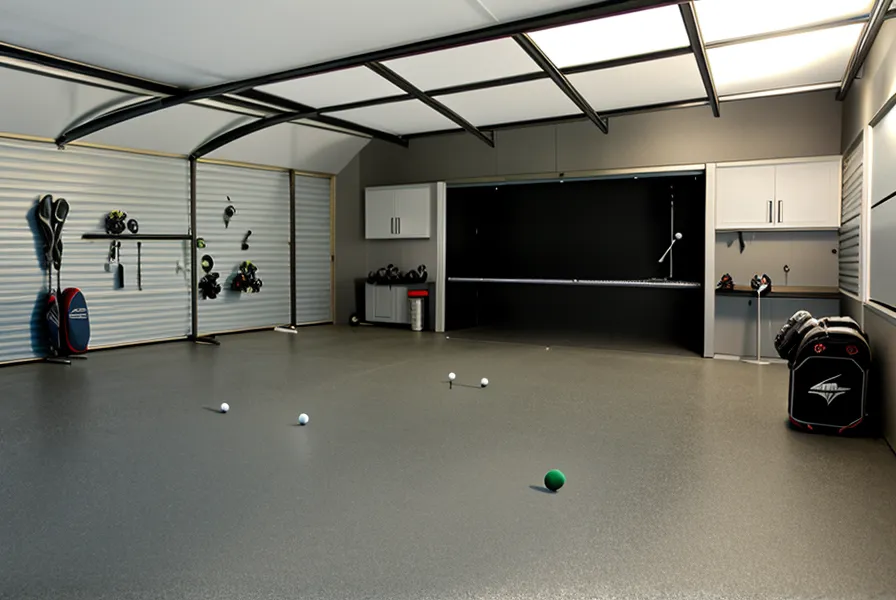
Counting the returns before a garage golf simulator setup actually earns its square footage would be a long exercise, and I lost count somewhere past the second mat, with the honest answer still a work in progress, just a two-car garage in suburban Cincinnati with one bay permanently converted into a launch monitor build, a knee that dictates how often I use it, and enough receipts to paper a wall.
Photometric Cameras vs Radar: The Launch Monitor Call a Garage Forces
The decision that actually matters first is camera versus radar, because square footage makes that choice for you in a two-car garage. SkyTrak Golf relies on photometric cameras, stacked high-speed images of the ball in the first few inches off the clubface, rather than tracking the ball's full flight the way Doppler radar systems do. Radar wants room to watch a shot travel; a camera only needs a clean look at impact, which matters when your hitting bay is a converted parking spot and not a driving range. Whether the numbers a system like that spits out are accurate enough to trust is a question I've chewed on at length elsewhere, and I won't relitigate it here. What a launch monitor actually reports back after each swing, ball speed, carry distance, spin rate, is its own long conversation too, and no single paragraph does it justice.
A reader named Chadwick emailed me after a piece comparing SkyTrak against a Garmin R10, three paragraphs with his exact ceiling measurement, asking which monitor I'd actually buy today if I were starting from zero. I told him the camera-versus-radar call matters more, once, than any spec sheet does afterward, because a photometric system drifts as garage light shifts from morning to evening, and recalibrating becomes a chore repeated forever rather than a box checked once during setup.
Why I Paid More Upfront for the Indoor Golf Shop Bundle
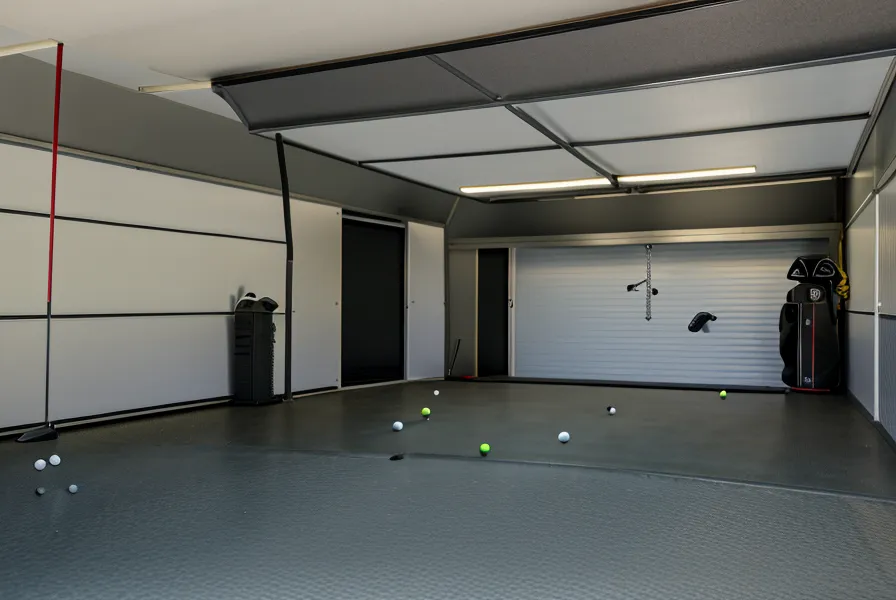
Once the launch monitor is settled, the next real fork in the road is whether to buy the shell of the simulator as one package or stitch it together from whatever's on sale. I went with Indoor Golf Shop for the enclosure and the mat after their design team walked through my garage dimensions, and paying more upfront bought me a few things piecemeal shopping doesn't guarantee.
Ceiling height is the garage-door clearance of this hobby: without enough room for a full driver swing clear of anything overhead, you're going to hit something expensive, and a bundle vendor flags that before you commit rather than after. The mat matters more than it looks too, since the padding underneath decides how much shock travels up through a knee on every strike, not just how the turf photographs. I returned two mats before landing on the SIGPRO that came in the bundle -- both felt like hitting off a sidewalk with carpet glued on. Expensive carpet, at that.
An impact screen takes a direct hit from a ball moving fast enough to matter, over and over, and a cheap one shows you that within weeks rather than years. Four walls and a net versus an open bay with a screen on one side changes how forgiving a mis-hit actually is, which isn't a decision you want to make after a shank puts a dent in drywall. Nineteen feet separate my setup from the back wall where the screen hangs, and the floor underneath is poured concrete with one old stain over by the side wall that's outlasted three mat swaps. Alignment inside the bay, how square the mat and screen sit relative to each other, is its own quiet source of bad data, and I didn't take it seriously until a stretch of unexplainable misses to the left. None of the rest matters if a stray shot off the toe doesn't stay contained in the bay, which is the one failure mode that turns a golf hobby into a homeowner's insurance claim.
What My Data Actually Showed About the Garage Gap
My 7-iron carries about five yards short indoors compared to an actual course, a gap consistent enough that I started calling it The Garage Gap and treating it as a correction factor instead of a flaw. Photometric cameras don't care that the ball only travels ten feet before it meets the screen, since they read spin off the ball's surface in the first instant of flight rather than guessing from a longer trajectory the way a radar unit does once it loses the ball early. Whether any of that actually translates into playing better on a real course is a separate question, one I worked through in a reality-check piece comparing my sim numbers against real rounds.
The clearest single piece of evidence sits in a dispersion chart from a Tuesday night on the sim's Pebble Beach, hole eighteen, four approach shots clustered inside eight yards of each other, tight enough that I grabbed a screenshot before the next round overwrote it. None of that happens if the picture on screen is washed out, and ambient light bouncing off a white garage wall will flatten a projected image faster than a cheap bulb will. The computer running the course software matters just as much and gets zero attention until a frame stutters mid-swing and throws off tempo on the next shot.
A garage swings from furnace-dry in January to stifling by July, and whether this thing actually gets used in August depends more on that than on any spec sheet. Side-spin reads in particular get flaky under specific combinations of face angle and lighting, which is its own troubleshooting rabbit hole I won't pretend to solve here. I also tried a subscription swing-analysis app for about six days, recording a clip and uploading it after every session, before the upload step alone killed whatever motivation got me out to the garage in the first place. Six days, then nothing.
The Putter, the Cart, and the Rest of the Ecosystem
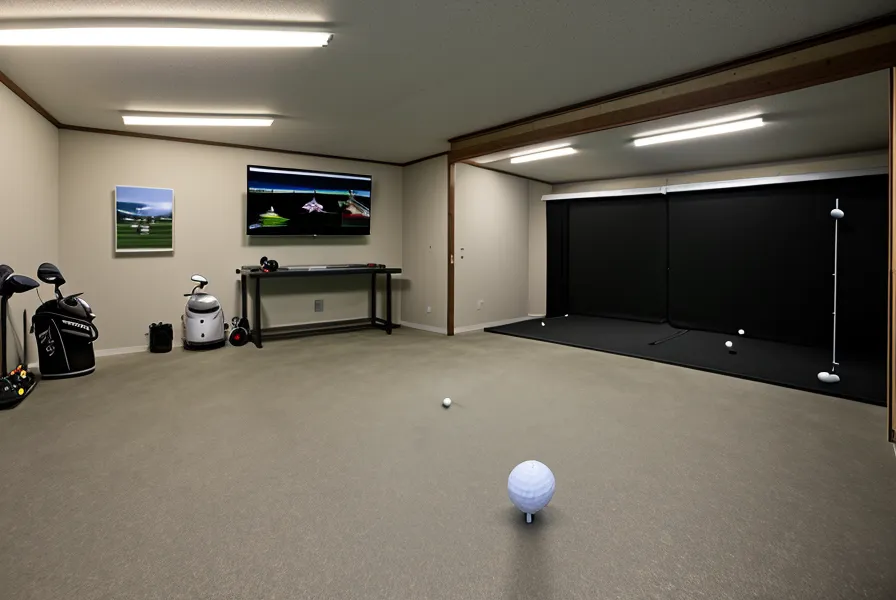
Putting is where money gets spent that has nothing to do with data. A SWAG Golf putter now lives in the rotation, milled from stainless steel that's overkill for a guy who still three-putts his own practice green, but holding something substantial makes the repetition feel like a hobby instead of a drill. SWAG's putters carry real tour pedigree too (Anna Nordqvist won a major with one in 2021), which is a strange thing to think about while missing a four-footer on foam turf. My wife, under a standing ban on new simulator purchases through December 2026, was unmoved by the craftsmanship argument.
An electric push cart from Alphard Golf sits folded in the corner for the actual course days the knee still allows, maybe once a month. The two-year warranty on the frame was the deciding factor over a cheaper no-name cart, since the folding hinge is usually the first thing to fail on carts like this. It's part of the same ecosystem I broke down at length in a longer piece on what actually earned its keep after a year of this build.
Storage turned into its own small project once a bag, a cart, a net, and a mat all started competing for the same twenty square feet, which forced a round of shelving that pulls double duty as regular garage storage the rest of the week. My neighbor Wes texts me Costco listings whenever a launch monitor two generations old shows up marked down, which is the piecemeal instinct in its purest form: chase the deal, skip the bundle, accept the gaps that come with it.
Bundle It or Build It Piece by Piece
Golf Direct Now is worth a look if you're still in the browsing phase, mostly because it's a generalist that will also sell a backup driver or a push cart in the same order. Their mat and screen selection is thin next to a specialist though, and return policies between any of these sellers are worth reading before checkout, not after an enclosure shows up damaged and you're stuck negotiating a return.
So here's the actual answer, not a hedge. If someone else should measure your garage, hand you a parts list, and ship the whole thing as one freight pallet, pay the bundle premium and go with Indoor Golf Shop or something built like it. If you already know your ceiling height, don't mind researching mats and screens separately, and want to chase deals the way Wes does at Costco, the piecemeal route through a generalist or direct brand sites saves money at the cost of your own research time.
I spent close to $5,000 landing somewhere between those two approaches, and the honest tally says the bundle money was well spent while most of the piecemeal savings got eaten by return shipping anyway. Measure your ceiling before deciding either way. Then measure it again, because SkyTrak Golf's current package options are worth checking against the garage you actually have, not the one in a YouTube build tour.
| Product | Rating | |
|---|---|---|
| SkyTrak Golf Garage Pick | 9.2 | Read More → |
| Indoor Golf Shop | 8.8 | Read More → |
| Golf Direct Now | 8.4 | Read More → |
| Alphard Golf | 8.6 | Read More → |
| SWAG Golf | 8.1 | Read More → |
SkyTrak Golf
Pros
- + Photometric cameras provide clinical accuracy for spin on short wedge shots
- + Small footprint fits perfectly on a garage floor without needing 15 feet of depth
- + The software ecosystem makes playing actual courses like Pebble Beach feel immersive
- + Reliable ball-flight data helped me maintain my 14-handicap during knee rehab
Cons
- ✗ Requires a subscription to unlock the best course software
- ✗ Can have occasional misreads if your garage lighting is too bright or uneven