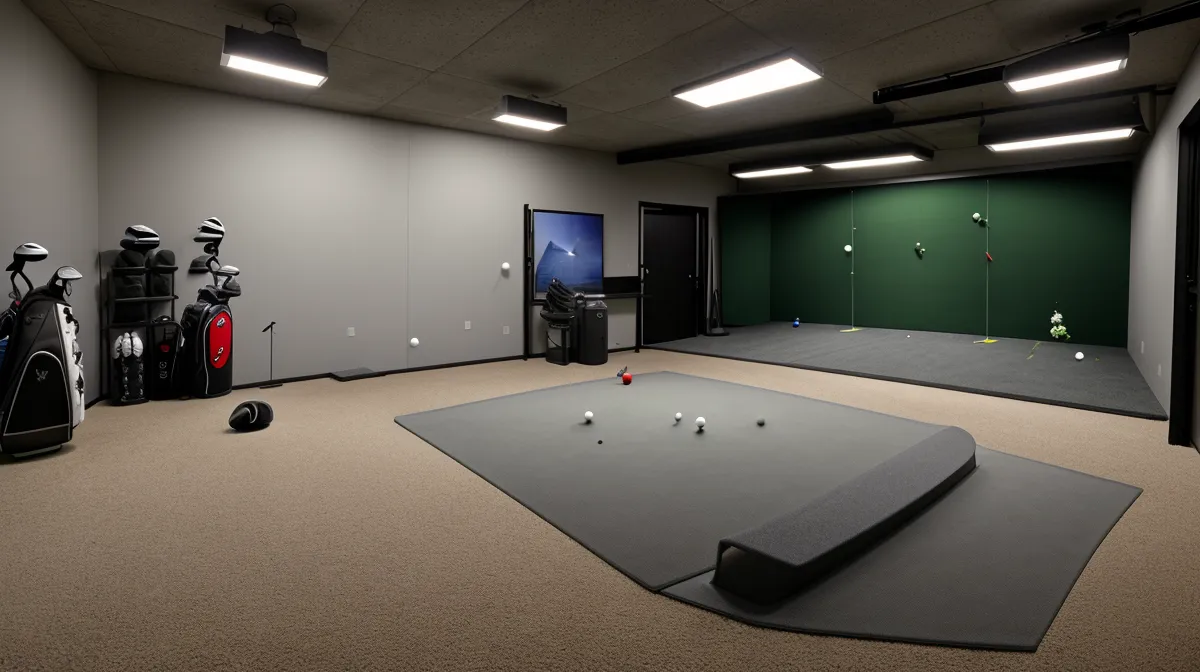
How much ball-flight room do you actually need before a launch monitor in a two-car garage stops giving you numbers you can trust? That question sat unanswered in my head through most of a rebuilt knee and a stretch of weekends that used to mean eighteen holes and turned into a couch. Indoor golf isn't a replacement for the course — nobody who has tried both would claim that — but for a mid-handicapper trying to keep a golf swing alive between real rounds, a garage build is the only version of the game that survives a suburban Cincinnati winter. This is a comparison, not a highlight reel: two launch monitor technologies, two ways to source the rest of the bay, and which combination actually earns its square footage.
Before any of that — the links to launch monitors, mats, and simulator gear below are affiliate links, and I get a commission if you buy through them without paying a cent more yourself. I only put a product into a comparison after running it in my own bay or boxing it up and sending it back, which is why some of the opinions below aren't exactly rosy.
Which Launch Monitor Technology Actually Fits a Mid-Handicapper's Garage?
Every launch monitor on the market measures some combination of the same handful of numbers: ball speed off the face, launch angle, spin rate, and the carry distance those three add up to. Better units add club data on top — face angle and path at impact — which is the piece that actually explains why a shot missed instead of just how far it went. The technology used to capture those numbers splits into two camps. Photometric systems use high-speed cameras to photograph the ball in the first few inches after impact, the same basic principle as a burst-mode camera in a studio shoot. Radar-based systems track the ball, and sometimes the club, with Doppler radar the way a highway speed gun tracks a car, which needs real distance downrange to get a clean read.
That difference matters more in a garage than anywhere else golf gear gets used. A photometric setup like SkyTrak Golf only needs a few feet of ball flight to do its job, so it can sit close to the mat with a screen just beyond it — useful when your swing room and your ball-flight room are basically the same slab of concrete. Radar units want more room to track the ball's actual flight path, and in a garage that room is exactly what's missing, which is the practical reason mid-handicappers building a two-car-garage sim skew toward photometric gear. Most two-car garages give you a nine-foot ceiling at best, and clipping the door opener with a full driver swing is its own separate headache — a ceiling-clearance problem, not a launch-monitor problem, and worth sorting on its own before you buy either.
Accuracy is the other half of the decision, and it isn't the same question as how many numbers a unit shows you. A launch monitor that reports six decimal places of spin rate is useless if those numbers don't lead to a swing change you can actually make on a Tuesday night — the threshold for accurate enough to act on shifts depending on the price tier you're shopping, and a mid-handicapper doesn't need the same precision a fitter chasing a tour player needs. SkyTrak pairs its camera with dual Doppler radar for the club and ball data, which is the combination that convinced me the numbers were something to trust instead of something to argue with. The trade-off is that the camera prefers warm, even light — a garage in the middle of winter without heat can turn calibration into its own project, and the full course library sits behind a membership on top of the hardware cost.
A guy I work with, Conrad, has been running his own basement setup longer than I've had mine, and he talked me out of a radar-based upgrade twice — not because the technology is bad, but because it didn't move his own numbers when he tried it side by side with what he already owned. That kind of pushback is worth more than another spec sheet.
Taking the Data From the Garage to the Course
The software layer is where a launch monitor stops being a sensor and starts being useful. A number on a screen means nothing until you can see the shot shape that produced it, and every course or practice mode is really just a way of turning ball speed, spin, and launch angle into a picture your brain can learn from. On a dark winter evening a projector does most of that translation, and getting the throw distance and mount right in a garage with a real ceiling is enough of its own project that I wrote a separate guide on how to mount a golf simulator projector in a low ceiling garage instead of trying to cram it in here. Ambient light matters more than most first-time buyers expect — a garage door cracked for airflow or a window at the wrong angle washes out contrast on even a decent projector, which is a lighting problem, not a launch monitor problem, and worth solving on its own.
It was a Wednesday morning, reaching down to tie a shoe before work, when I noticed my knee hadn't complained in days. I don't credit a golf simulator with fixing a surgically repaired joint — that's not how any of this works — but a mid-handicapper who can only get to a real course a handful of times a month needs some way to keep swinging without paying for it the next morning, and hitting off a forgiving mat in a heated garage is a gentler version of that than eighteen holes on a hilly course. When I do get out to Sharon Woods Golf Course on a weekend, the numbers hold up well enough that I trust the garage sessions in between — a 7-iron carrying somewhere in the high 140s with a swing speed that sits in the high 80s reads about the same whether I'm on the mat or standing on the tee box. That agreement between the two environments is the actual value of the data, not the data itself. (My wife's only rule is that the garage door stays down after nine, so the neighbors don't get a Tuesday-night highlight reel.)
Mats, Bundles, and Where Each Vendor Actually Fits
Mats are their own rabbit hole, and I went through more than one before landing on something that didn't turn every practice session into a referendum on my surgically repaired knee. The short version is that surface feedback under a joint that's already been operated on isn't a place to cut corners, and I've written the long version separately in my guide to best golf hitting mats for garage simulators. A guy I know from the local sim-builder Discord, Nate Grullón, will text me his opinion on mat thickness at eleven at night whether I asked for it or not, and more often than not he's right.
Once the mat question is settled, the rest of the bay comes down to bundle-from-one-source or piece-it-together-yourself. Indoor Golf Shop sells full packages that bundle the launch monitor, enclosure, mat, and projector together, and their in-house SIGPRO mat and screen lines have a decent reputation in the garage-build community — their design team will even work from your actual garage dimensions before you commit to anything, which matters more than it sounds like, since most two-car garages already have something else — a water heater, a shelving unit, a second car some nights — eating into the space you were counting on. The catch is that bundle pricing means paying for pieces you might have skipped buying individually, and a full enclosure kit like their SIG12 shows up as a freight delivery rather than a box on the porch, so budget time for uncrating it and probably a second set of hands. Whether you enclose the whole bay in a kit or leave it open behind a freestanding screen is a related but separate decision, and it's worth researching before you order either piece.
Going piecemeal means shopping around, and for the non-simulator-specific stuff — a backup driver, a practice wedge, a second push cart — Golf Direct Now tends to beat the big-box stores on price and carries enough brand variety that you can order everything in one cart. It isn't a simulator specialist, though, so its mat, net, and screen selection is thinner than what you'd find at a dedicated shop, and shipping speed gets inconsistent once you're ordering during their busy season. The first screen I put up myself was a foam-padded panel I sourced on my own, not through either vendor above — it looked plush enough to take anything. It split clean along the seam after the third bucket of balls. No warning — just a seam giving way mid-session, which is the kind of failure that never shows up in a product photo. How durable a given screen actually is under repeated impact, and where a net or barrier needs to sit to catch what the screen misses, are both deep enough topics to deserve their own comparisons rather than a paragraph here — that one panel just taught me to stop guessing.
The Cart, the Putter, and the Rest of the Bay
Not everything in a garage golf budget is simulator gear, and it's worth separating what actually improves your indoor sessions from what just makes the space feel more like golf. On the rare weekends I get out to a real course, I've stopped carrying my own bag — an electric push cart from Alphard Golf handles that now. Their Cybercart picked up a 2025 MyGolfSpy Best Overall award for electric push carts, which is a harder thing for a smaller brand to win than the marketing copy makes it sound, and the frame carries a two-year warranty against the folding-mechanism failure that tends to kill cheaper carts. The auto-follow mode means I can carry a coffee instead of a remote down the fairway, though the battery isn't invincible — enough owners have reported needing a replacement before hitting the full warranty cycle count that it's worth budgeting for eventually, and the folded cart still won't fit a compact trunk without pulling the bag out first.
And then there's the putter, which has nothing to do with launch monitor accuracy and everything to do with wanting one nice piece of gear in a garage otherwise full of practical purchases. I picked up a SWAG Golf putter milled from 303 stainless steel — the same brand Anna Nordqvist used to win the 2021 AIG Women's Open — and the face milling gives a roll on a real green that a garage mat can't fake. Is it overkill for a guy putting on foam most nights? Without question. But the limited-drop model means the ones you actually want sell out within minutes of release, so waiting around and comparing specs is the wrong strategy once you've seen one you like. None of it changes how flat your garage floor needs to be for a mat to sit right without shimming — that's a concrete-slab question worth answering before any of this gear shows up on your porch.
So Which Setup Actually Wins for a Mid-Handicapper?
Neither comparison in this piece has a universal answer, but both have a clear enough logic to follow. Choose a photometric launch monitor when your garage gives you swing room but not much ball-flight room, which describes most two-car garages, and you're willing to manage light and a membership fee in exchange for a setup that works a few feet from the mat. Choose a radar-based unit only if you've genuinely got the downrange distance for it to track cleanly, and even then, get a second opinion from someone already running one before you commit, the way Conrad talked me out of it twice. On the sourcing side, choose a bundle when your time is worth more than the markup and you want one company accountable if a piece doesn't fit your garage; choose piecemeal when you already know exactly which mat, screen, and net you want and you're willing to chase separate shipping windows to get each one right. I went photometric and mostly piecemeal, foam screen failure included, and I'd make the same call again — just with a better screen the second time.