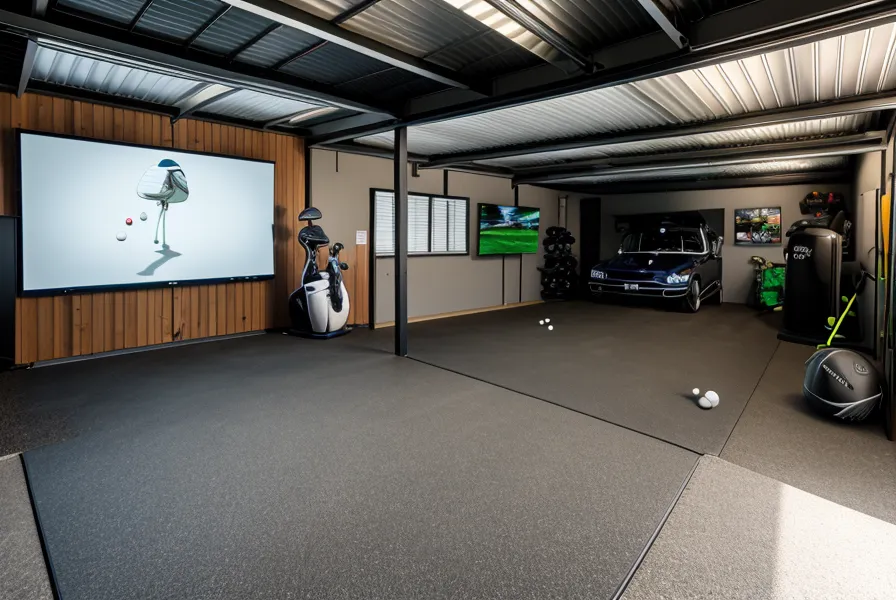
Seven miles an hour. That's the gap between my driver speed inside my garage bay and the same club twenty minutes later on an outdoor tee, and figuring out why took longer than it should have for someone who stares at dashboards for a living. Readers of this garage golf build ask some version of the same question almost every week: if the launch monitor says my swing is this consistent, why does it fall apart the moment I'm standing on real grass? So instead of another gear update, here's a straight question-and-answer on swing consistency, indoor golf numbers, and why a 7-iron that looks flawless on a simulator screen can turn into a completely different club outside.
Why Does the Garage Swing Feel Different From the Course Swing?
The short answer is that walls do more to your brain than your body wants to admit. Even in a two-car bay with enough room to clear a full swing, some part of you clocks how close the back wall sits and shortens the finish before conscious thought gets involved. That showed up hardest on a 7-iron, the club I'd hit into my screen at the same distance more times than I could count before taking it back outside. On the course at Sharon Woods Golf Course in Sharonville, that identical swing turned into a thin shot well short of the green, because the motion I'd grooved indoors was never quite the motion I use with open sky overhead.
Numbers back this up better than feel does. Inside, my driver sits around 94 miles an hour on a clean pass. Outside, the same club and the same effort reads closer to 101. For a 14-handicap guy chasing carry distance, that gap is worth almost twenty yards, and none of it comes from trying harder on purpose. The ceiling in my head never actually left the garage.
In the garage, two nights a week, I'm playing Pebble Beach Golf Links without leaving the cul-de-sac, and the numbers on screen look good enough to make anyone overconfident. A knee that used to bark at me on every flight of stairs went quiet somewhere along the way, enough that I noticed it lacing up for work one ordinary Wednesday morning and realized it hadn't said a word in days. I covered that part of the story over in Garage Golf and Knee Recovery: Why My SkyTrak Setup Beat the Physical Therapy Routine, so I won't repeat it here beyond saying the swing-consistency headaches are a fair trade for a joint that finally calmed down.
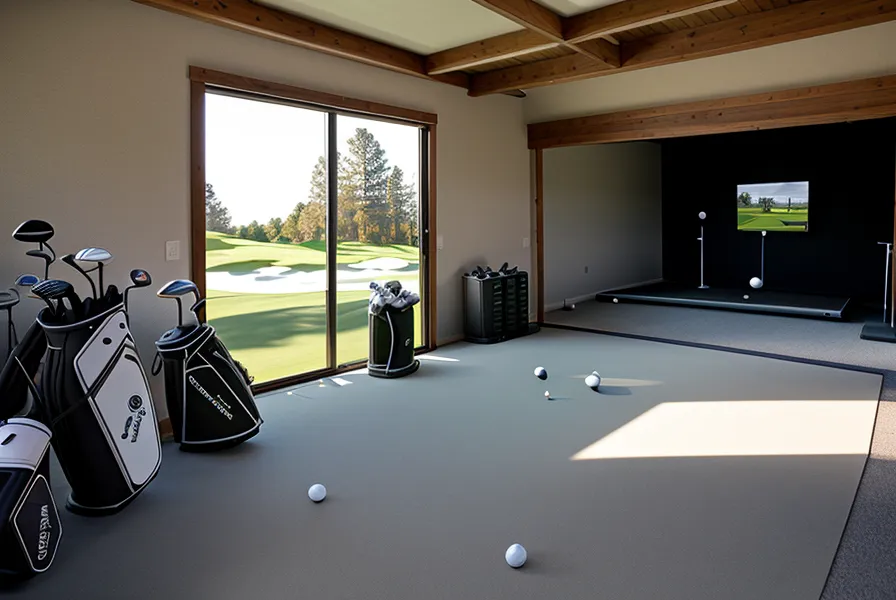
Indoor Swing Syndrome Is Real, Not an Excuse
Guys on simulator forums call this Indoor Swing Syndrome, and before I lived through it, I assumed it was an excuse people used after a bad session. My impact screen is rated to take a ball at 250 miles an hour without blinking, so logically nothing about hitting into it should change my swing. Logic loses to instinct here. Some part of the brain senses a wall ten feet away and quietly protects against an impact that was never going to happen, steepening the plane and shortening the follow-through without asking permission.
Before the garage setup existed at all, I tried to solve the space problem the cheap way with a pop-up hitting cage in the backyard. It survived exactly one Ohio winter before the snow load buckled the frame, which is the actual reason I gave up on anything outdoors and cleared out half the garage instead. That failure is probably the most useful lesson buried in this whole build: anything set up outside in this climate needs to survive ice, not just rain.
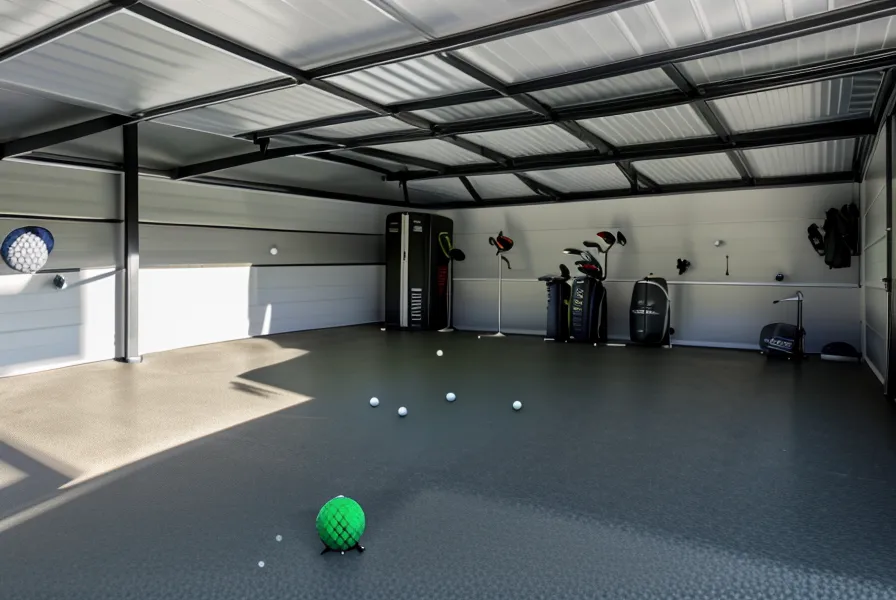
Does More Launch Monitor Data Actually Make Me a Better Player?
Not automatically, and this is the part guys who drop serious money on a launch monitor don't want to hear. My unit tracks ball flight through high-speed cameras, which catches things a human eye never would, like a 7-iron spinning at roughly 7,500 RPM off a slightly heavy strike. The simulator punishes that shot with a sharp distance drop. On real turf, with a little roll and a bit of wind, that same strike might still finish on the front of the green. Chasing the number on the screen instead of the shot in front of me is how I ended up swinging harder and getting worse.
A launch monitor behaves more like a bathroom scale than a kitchen one. You don't need it accurate to the gram to know if you're trending the right direction, and checking it after every single swing turns practice into fidgeting with grip and ball position over a number the real course would have ignored anyway. Exactly how accurate that ball-flight data is depends on more variables than fit into one answer, but the practical version holds up: trust the trend across sessions, not the one bad reading from a single mis-hit.
Closing the Gap Without Buying More Gear
Fixing this didn't cost another dollar (my wife noticed, which matters given the purchase freeze she's had me under until December 2026). I stopped treating the impact screen like a target and started treating it more like a movie screen that happens to sit in the flight path, which sounds like a small mental shift but changed how close I set up to it. Moving the hitting mat back a few inches gave my eyes more room before the screen fills the view, and that alone took some of the flinch out of a full driver swing.
Clip the leading edge of the mat on a fat shot and the rubber tee kicks back upright like nothing happened, which used to bother me more than it should. Now I let a handful of ugly spin numbers go by before touching my grip or stance, and the swing I bring to the course looks a lot closer to the one I use on Tuesday and Thursday nights in the garage. The $200 "premium" hitting mat I returned early in this build taught me the same lesson from a different angle: I was convinced it was causing a slice until I put a cheaper mat under my feet and sliced the exact same shot. The mat was never the problem.
What actually earned its spot in the garage after a full year of swapping gear in and out gets its own breakdown in the midlife sim build and what actually works after a year in my Cincinnati garage, which has more detail on specific gear than fits here.
The Other Questions I Get About Garage Numbers
A friend of mine who spends every weekend coaching his daughter's travel soccer team is usually the one firing these questions at me over text, since a weeknight garage session is about as close as he gets to playing right now. Whether a flatter concrete floor changes launch monitor readings comes up often enough that it deserves a full answer on its own rather than a guess here. Ceiling clearance gets asked about constantly too, since a standard garage door opening doesn't leave much room for a full driver finish, and that's a bigger topic than one paragraph can cover fairly.
People also want to know how long an impact screen holds up against real swings before it needs replacing, and whether the core numbers these units report, carry, spin, launch angle, mean the same thing machine to machine. Lighting comes up too, since a bright projector image is only as good as how dark the bay behind it gets. A couple of readers have asked whether calibration drifts on these units over repeated sessions the way an old scale does, and whether garage practice actually moves a handicap the way people hope. Fair questions, every one of them, and each deserves more room than a quick answer gives.
None of this makes the gap disappear completely. Unless the ceiling in your garage is closer to a barn than a two-car bay, your brain is always going to know it's standing in a room, and the swing you bring outside will drift a little from the one the screen sees. What changed is how much I let that gap bother me. Close to five thousand dollars into this hobby, I'd rather trust a consistent, slightly-off-from-real-grass swing on a Tuesday night in the garage than not swing a club at all, and that's the real answer underneath every version of this question I get asked.