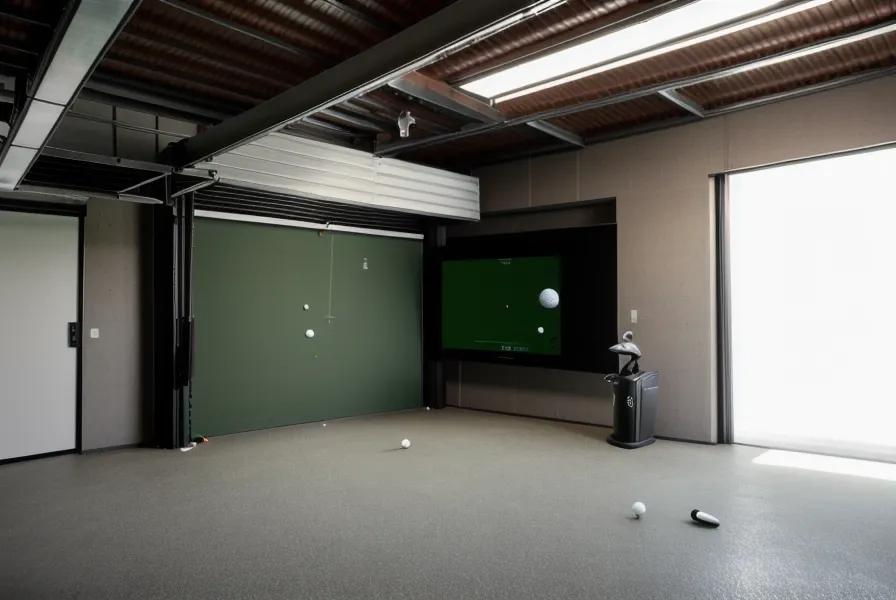
My 7-iron catches the mat a half-inch fat and the jolt doesn't stop at my wrists. It runs straight up through my surgical knee like somebody tapped a tuning fork against the joint. That's the part most indoor golf advice skips entirely: the hitting mat gets treated like a doormat you throw down to keep the concrete from looking bare, when it's actually the one piece of injury-prevention gear standing between your joints and a slab of concrete.
Nobody warns you about this before you buy. The common assumption, the one I bought into completely, is that any mat with green fibers glued to a foam pad performs about the same as any other, and that softness alone is what keeps your joints safe. That assumption is backwards, and figuring out why cost me a returned mat, a knee that ached longer than it should have, and enough late-night research to make my wife ask if this garage project was quietly turning into a physical therapy co-pay generator (she was not wrong).
The Indoor Golf Myth: Any Hitting Mat Will Do
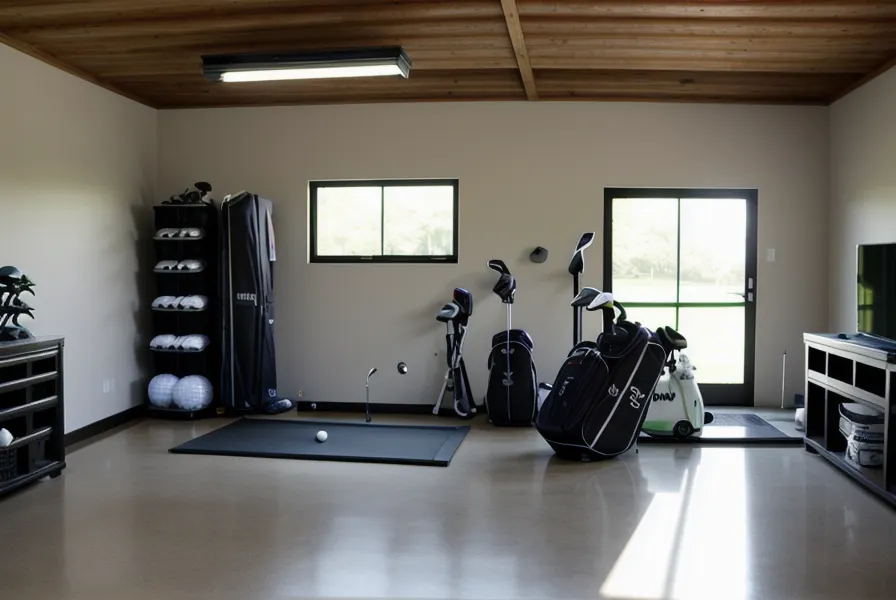
When I cleared the family van's half of the garage for a SkyTrak Golf setup, the launch monitor and the screen ate up all my attention. Ceiling clearance for a full driver swing turned into its own headache, the kind of measure-twice project that deserves its own post. Deciding between a golf hitting net vs impact screen, and whether either would hold up to a full season of range balls, took up another few weekends. The mat got maybe fifteen minutes of thought, because in my head turf was turf and the real gear was everything sitting in front of it.
That fifteen minutes is exactly the mistake this whole post is about. A mat is the only surface between a real swing and a concrete slab, and treating it like an afterthought is how a joint with a surgical history ends up paying the bill instead of your wallet.
What a Cheap Mat Actually Does to Your Joints
A generic mat from a generalist shop like Golf Direct Now looked like the smart move: cheap, fast shipping, and it saved enough that I turned around and bought a SWAG Golf putter my wife still hasn't clocked as a different brand than my old one. For a few weeks it held a tee fine and looked the part. Then the thin foam backing started compressing under regular use, and it stopped being turf and started being a green-colored lie sitting on top of Ohio concrete. That mat went back in the box it shipped in before the return window closed.
Catching a 7-iron a half-inch fat on a real fairway costs you ten yards and a slightly bigger divot. On a compressed mat it costs you a jolt straight up your lead leg, because the club head blows through dead foam and taps concrete on the way. That cheap tee never sat still either. It kicked back upright every time contact happened low on the mat instead of clean on the ball, a small twitchy tell that not much shock was actually being absorbed. Around the same stretch my SkyTrak unit started throwing odd numbers on back-to-back shots, and I never fully sorted out whether the ball was wobbling on a softening surface or the unit itself had shifted, which is its own argument for why ball-flight data is only as trustworthy as the mat sitting under it.
A trip to PGA Tour Superstore in Deerfield Township on a lunch break confirmed I wasn't imagining things. Standing on their demo hitting bay for five minutes felt nothing like standing on the bargain mat in my garage. It reminded me of a backyard pop-up hitting cage I'd tried the fall before the SkyTrak went in, the kind of net-and-frame kit that seemed like a reasonable stopgap until it survived exactly one Ohio winter before the frame buckled under the snow load and the whole thing went to the curb. A neighbor who spends every weekend coaching his daughter's travel soccer team wandered over while I was hauling the busted cage out, took one look, and asked why I hadn't just started with the garage in the first place. Fair question.
Foam Density, Slab Level, and the Real Injury-Prevention Checklist
Somewhere around then I stopped treating entry-level mats as a budget category and started treating them as an injury-prevention category, especially for anyone over thirty or anyone carrying a joint history into the garage. Cheaper mats degrade faster than the marketing copy admits, and once the backing loses its elasticity, your joints inherit the difference. Researching the SIGPRO line at Indoor Golf Shop was the first time I saw a mat description that talked about foam density and give in the same breath as proprioception instead of just describing the color of the fake grass.
When the SIGPRO mat showed up, it didn't arrive rolled in a tube. It came on a pallet with the kind of weight that told me something before I'd even opened the box. It smelled like fresh industrial foam and dense synthetic grass, and unlike the bargain mat, it didn't slide an inch on the concrete during a full driver swing. What I hadn't accounted for at all was the slab underneath it. A concrete floor that isn't perfectly level changes the effective lie angle the moment you set a heavy mat on top of it, and a stance foot sitting even slightly lower than the ball loads one knee more than the other before you've swung a single club.
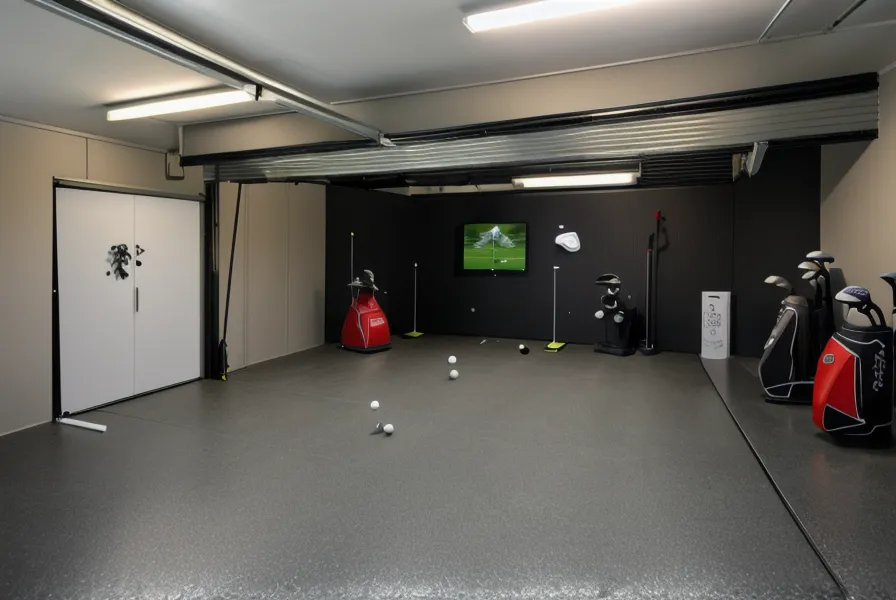
None of that touches the other rabbit holes that came with this build: whether an enclosure is worth it over an open bay, how much a projector fights with ambient light once the garage door goes up on a nice afternoon, keeping a mis-hit from putting a dent through drywall instead of a net, or what smash factor and spin actually mean once you stop staring at the ball-flight animation. Those are each their own decision. The mat isn't any of them; it's just the one piece you can't fix with better software.
So What Should a Garage Simulator Owner Check Before Buying?
So here's the actual checklist, not the marketing one. Look for a replaceable hitting strip, which tells you the maker expects you to wear the thing out and planned for it instead of hoping you don't notice. Check the weight and backing of the mat itself. If it slides during a full swing, it isn't stable enough to trust your joints to. Before you blame the mat for anything, put a level on your garage floor, because a slab that tilts even slightly loads one side of your body no matter how good the foam is. Test it in person if you can. A demo bay at a store like PGA Tour Superstore will tell you more in five minutes than any spec sheet.
Budget Mat vs. SIGPRO, Side by Side
None of this is theoretical, and it isn't just about mat brand either. My gear-heavy brain still has to admit the 2025 MyGolfSpy-winning Alphard Golf Cybercart is a genuinely good cart for the one real round a month I still play outside, especially with a warranty that covers the frame instead of just the wheels. But that cart doesn't touch how my knee feels after twenty minutes in the garage. Here's how the two mats actually stacked up once I'd lived with both of them.
| Feature | Budget 'Generalist' Mat | SIGPRO (Indoor Golf Shop) |
|---|---|---|
| Shock Absorption | Minimal (Concrete feel) | High (Proprietary foam) |
| Durability | Compressed in 3 weeks | Replaceable hitting strips |
| Stability | Slides during driver swings | Heavy, non-slip backing |
| Price Point | Under $200 | $500 - $1,000+ |
Price cuts both ways here. The upfront number on the SIGPRO side is real money, but so is a knee specialist co-pay, and only one of those two costs shows up on a receipt you can plan for in advance.
The Real Fix Wasn't Softness: It Was Stability
The lesson wasn't that softer is safer. A mat that's all give and no backbone just trades one problem for another, since an unstable base under a driver swing is its own injury risk. Stability, foam density, and a level slab underneath all had to work together before my knee stopped complaining. Last Thursday I grabbed a 9-iron in the garage with zero warmup, nothing deliberate about it, and the ball carried to almost exactly the number I'd expect off a real range, no wobble, no argument from the launch monitor, no twinge on the follow-through. That's what a mat doing its job actually looks like: not that it resembles a fairway, but that your knee stops being part of the conversation mid-swing.
If you're building out a garage setup and you're past the age where your joints forgive bad decisions, start at Indoor Golf Shop rather than whatever mat ships fastest. Their bundles are built by people who assume you're not a 22-year-old with knees that bounce back overnight. My wife's ban on new purchases is still in effect, but since I'm not limping into the kitchen after a garage session anymore, this setup gets to stay exactly as it is for a good while.