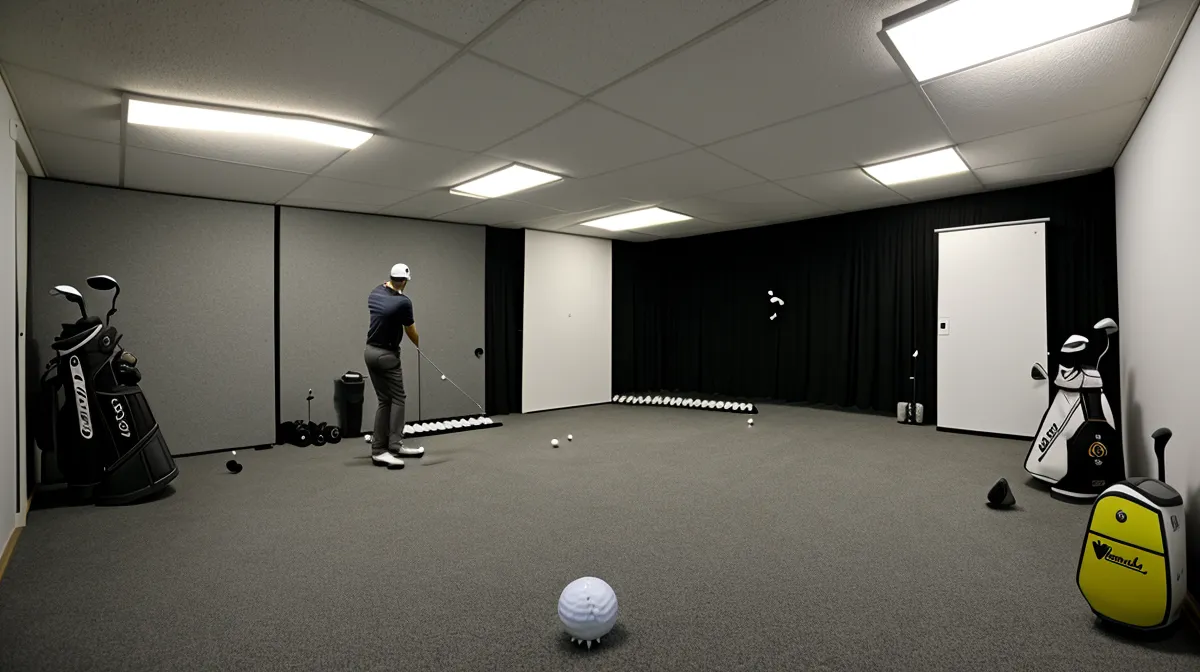
A hitting net stops a golf ball. An impact screen stops the same ball and turns it into a target you can actually watch land. That difference is the whole argument buried inside every garage simulator build, because the piece of indoor golf gear you pick decides whether your SkyTrak setup ends up feeling like a driving range bay or an actual round of golf, and in a small garage that decision also decides how much depth and ceiling you have left over for anything else.
Before any of this went into the garage, I paid for a membership at a commercial indoor range forty minutes from the house. Two visits in, I canceled it. Forty minutes there, forty minutes back, for less practice than the drive cost. Not worth it. That failure is the reason the rest of this build happened at home instead of somewhere else, and everything below is what actually held up once real swings started flying inside four walls, not what looked good on a spec sheet.
What a Hitting Net Actually Absorbs — And What It Doesn't
A basic hitting net from a place like Golf Direct Now earns its keep at exactly one job: catching a golf ball before it finds drywall. Mesh flexes across its entire face, so a shank six inches off the sweet spot gets swallowed the same as a flush strike down the middle, and that whole-face forgiveness is the real advantage a net holds over a screen in tight quarters. An impact screen only protects the rectangle directly in front of the mat — miss wide enough and the ball finds the enclosure frame instead of fabric, and a shank catching that steel rail makes a flat, hollow knock you feel in your hands before you register the sound. A net never does that part. What a net won't do is make the range feel like a round at Pebble Beach — you're still staring at blank mesh, then looking down at a tablet, and that gets old by the third or fourth session.

Why an Impact Screen Needs Room a Net Doesn't
Hang a net almost flush against the back wall and it works fine — the mesh gives, the ball drops, done. An impact screen can't do that. It needs roughly 12 to 18 inches of open air behind the fabric so the tensioning system can absorb the strike properly. Skip that gap and the ball hits screen, then drywall, in that order. Expensive order. In a standard two-car garage, giving up that extra foot of depth pushes the mat and the launch monitor closer to the garage door track, and that's before ceiling height even enters the conversation.
The enclosure I ended up with came from Indoor Golf Shop, and their SIGPRO screens are built around that depth requirement instead of fighting it — multi-layer polyester that also cuts down on impact noise, which matters when the room above the garage happens to be a bedroom. Indoor Golf Shop's design team will map your actual garage dimensions before you commit to gear, which is worth using once instead of guessing at tensioning specs yourself.
Ceiling clearance for a full swing is a separate calculation — I laid it out in Real Garage Golf Simulator Space Requirements for a Full Swing — and it's exactly what my next-door neighbor Patty checked with her own tape measure before I could even offer the number, when she stopped by to look at my setup while planning one for her retired husband. A floor that isn't level under the mat makes either setup feel worse than it actually is; concrete slab leveling is its own headache I won't get into here, but it compounds the depth problem if you skip it.
How the Launch Monitor Changes What the Screen Is For
None of the net-versus-screen argument matters much without something reading the ball in between. I run a SkyTrak MAX, which uses a photometric camera and radar to read the shot from right next to the mat — how accurate that read is compared to other launch monitor styles is a whole separate discussion I'll leave for elsewhere. What matters here is what a screen does with that reading versus what a net does: pair the monitor with a screen and you watch the ball flight land exactly where the ball hit the fabric, instead of reading a number off a tablet after the fact. A net hands you the same underlying shot data — carry, spin, ball speed — you just lose the visual confirmation, and that gap is most of what a screen buys you. My 7-iron carries somewhere around 155 yards on a clean strike, and that number means more watching it land on a screen than it ever did printed on a tablet.
My wife caught me at the kitchen table last month enjoying a ball-speed spreadsheet more than the round it came from, which tells you roughly where this hobby ends up. There's a separate question of which launch monitor metrics actually matter for a mid-handicap swing versus a scratch one, and that's worth its own read rather than a rushed mention here.
Durability Is the Real Difference, Not Just Feel
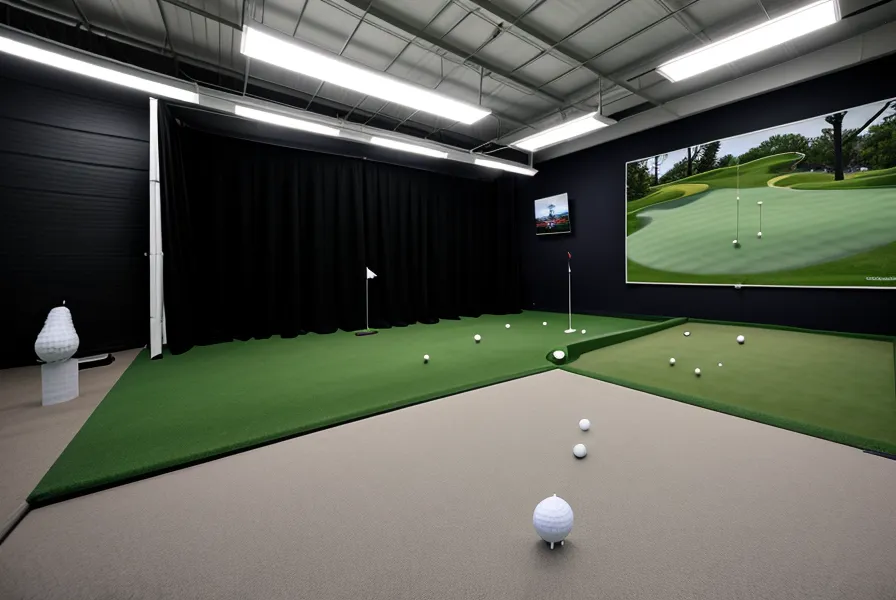
Here's the part that actually separates a net from a screen, and it isn't comfort or realism — it's what the material is rated to survive. Think of a net as a moving blanket: it just needs to stop something heavy without tearing. A simulator-grade impact screen is closer to a home theater screen that also has to survive getting hit — woven polyester or nylon built to take repeated full-swing contact at driver speed without deforming, session after session. A standard backyard hitting net was never engineered for that job. Hit one hard enough and often enough and it starts to billow forward into the projector beam mid-swing, smearing the image right when you need it sharpest. That's a durability problem wearing a picture-quality costume — the net isn't failing, it's just not built for what a screen setup asks of it. My wife's coworker Shona showed up once with a casserole dish and ended up watching a full virtual back nine at Augusta without complaining, which is the kind of buy-in a properly tensioned screen earns that a rippling net never will.
If you're not ready to commit to a projector and a properly tensioned screen, a net from somewhere like Golf Direct Now paired with a tablet stand is a legitimate way to keep hitting balls without opening that whole second budget line. It saves real money and a lot of mounting-bracket frustration, even if it's less convincing to look at. Go the enclosure route instead and tensioning is what actually keeps the trampoline effect in check — I broke that down in Top Golf Simulator Enclosure Kits for DIY Garage Projects, including the open-bay setups some guys run instead of a full box. Between the launch monitor, the screen, and the gear that didn't survive its return window, I'm close to $5,000 into this garage since 2024.
Two smaller things ride along with that durability question and deserve one line each instead of a detour: which mat you're hitting off changes how your joints feel over a long session, and how much ambient light gets into the garage changes how sharp the projected image looks regardless of fabric quality. Both are worth solving on their own; neither belongs in a net-versus-screen breakdown.
How Do You Decide Between the Two for a Small Garage?
Boil it down and the decision comes down to how you actually plan to use the space. If you want to keep swinging safely without a big investment, and you can live with reading your numbers off a tablet, a net does the job and leaves money for other things — I've still got a two-year-warranty Alphard Golf push cart on my list for actual course days, since a simulator doesn't do much for the walk up a real fairway. If instead you want the garage to be a place you choose over the couch on a 20-degree night, the screen-and-projector combination is the one that gets used through a whole winter instead of collecting dust by February. I've got a SWAG Golf putter on my own wishlist for whenever the simulator technically counts as paid off in saved greens fees — different math than net-versus-screen, but the same instinct: spend where the use actually happens.
If square footage is tight, start with the net. It's the safer bet and the one you're least likely to regret. But if the garage is where you've already decided you're actually going to play, measure your depth and your ceiling twice before ordering anything, because that gap behind the screen is the difference between a real simulator and a hole in the drywall. The bundles at Indoor Golf Shop are still the fastest way to get the monitor, screen, and enclosure sized right the first time, instead of piecing it together the way I did.