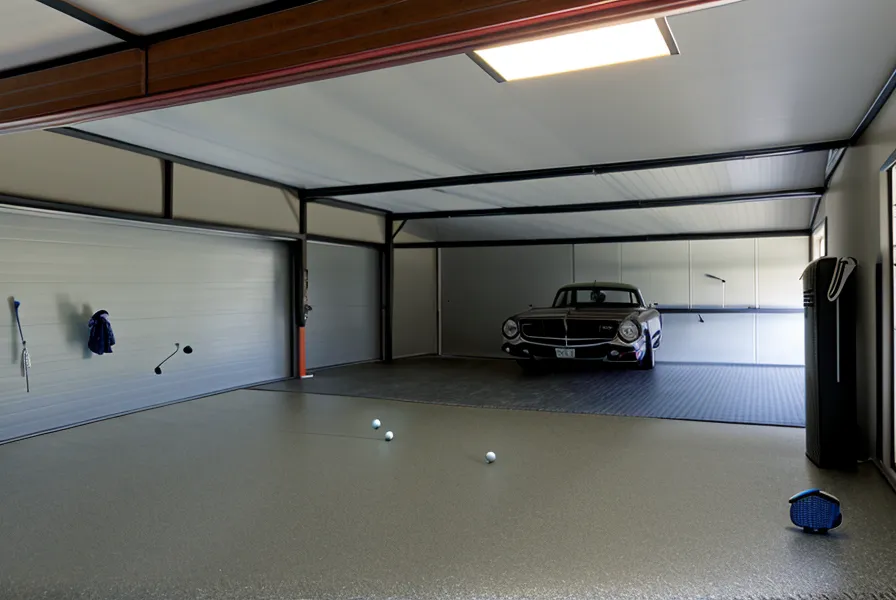
I was standing in my Cincinnati garage one sub-zero January night, shivering so hard I couldn't find the bottom of my arc, trying to loosen up my post-surgery knee while my breath literally fogged up the SkyTrak lens. My 2023 knee surgery already makes me feel like a rusty gate in the morning, but trying to swing a 7-iron in 28-degree weather was a special kind of masochism. I had spent close to $5,000 on this setup—clearing out half the family two-car garage, installing a SkyTrak Golf launch monitor, and hanging an impact screen that is basically a home theater screen designed to be hit by a 70 mph projectile—and there it was, gathering dust because I didn't account for the Ohio winter.
Quick heads-up before we get into the BTU talk: when you click through to a launch monitor or heater on this site and buy something, the vendor pays me a commission. The price at checkout is the same for you, but it helps me pay off the gear I’ve already bought (and keeps my wife from extending the SIM purchase ban past December 2026). I only talk about gear I’ve actually tested, returned, or spent way too many 2 AM hours researching in my own garage sanctuary.
The Cold Hard Truth About Garage Golf
By mid-November chill, I realized my dream of playing Pebble Beach on Tuesday nights was in jeopardy. A garage is essentially a concrete box that hates you. If you have a standard 9-foot-ceiling garage like mine, you’ve already done the math on swing clearance, but you probably didn't calculate the thermal mass of a concrete slab. Even with the door shut, the temperature drops fast. My first attempt at a fix was a cheap space heater I found in the basement, but it did about as much as a candle in a wind tunnel. My joints felt like they were full of gravel, and my launch monitor was giving me ball speeds that looked like I was swinging a pool noodle.
I eventually went down the rabbit hole at the Indoor Golf Shop to find heating solutions that wouldn't interfere with the tech. You see, launch monitors are like the camera setup in a YouTube studio; they need specific conditions to work. The SkyTrak ST MAX uses a photometric camera plus dual Doppler radar, and if you have a convective heater blowing dust and hot air directly across the sensor path, you’re going to get 'no-reads' or wonky data. I learned that the hard way after returning two different portable units that were more fan than heater.
Infrared vs. Convection: The Great Garage Debate
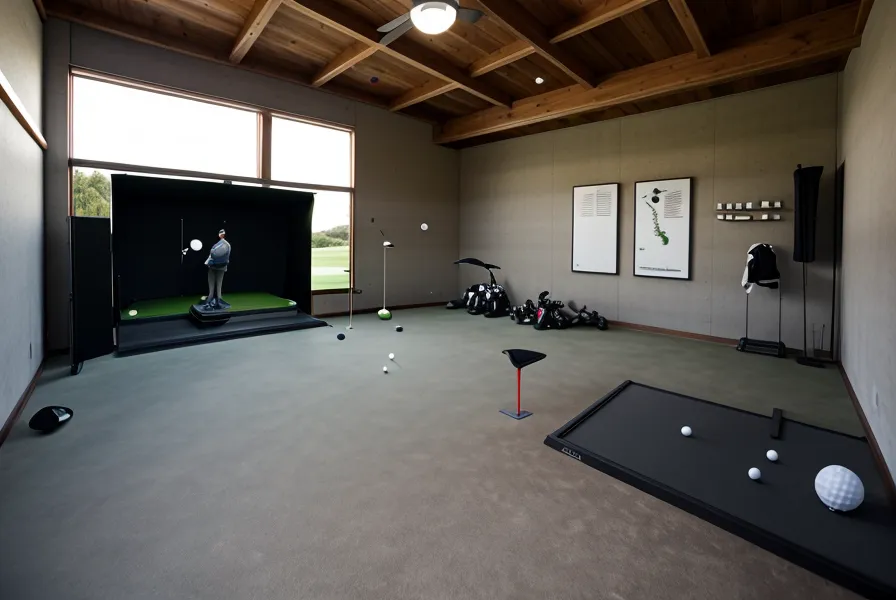
In the world of garage heating, you have two main choices: radiant infrared or forced-air convection. Think of it like this: a convection heater is like your car's heater—it warms the air, which then eventually warms you. Radiant infrared is like standing in the sun on a crisp fall day. It heats the objects (you, your mat, your clubs) directly without needing to warm every cubic inch of air in the garage first.
My unique observation after a full season of this: radiant infrared heaters provide faster surface warming for the golfer, which is a godsend for my knee, but they create larger temperature gradients across the room compared to forced-air units. If I stand right under the infrared heater, I’m toasty, but the far corner of my two-car garage stays frosty. However, for a simulator, infrared is usually the winner because it doesn't blow dust onto your expensive projector lens or vibrate the floor. I actually wrote about this in my My Routine for SkyTrak Calibration to Get Consistent Garage Data, because temperature stability is actually a huge part of sensor accuracy.
Why I Chose Radiant Heat
By late February, I settled on a ceiling-mounted infrared unit. I wanted something that wouldn't take up floor space—my swing path already feels tight enough with the lawnmower and the kids' bikes lurking nearby. When you're swinging a driver, you don't want to be worrying about tripping over a cord or knocking over a propane tank. Plus, the steady heat keeps the ball compression consistent. Did you know that compression changes as the ball's core temperature drops? If your garage is 40 degrees, that Titleist is going to feel like a rock and fly like one, too. Keeping the room at a steady 65 degrees made my 7-iron carry numbers jump back up to my usual 155 yards, rather than the 142 I was seeing in the dead of winter.
The Essential Gear for a Year-Round Build
If you're building this out, don't just buy a heater and call it a day. You need to look at the whole ecosystem. I’ve sourced a lot of my secondary gear from Golf Direct Now because they carry everything from backup wedges to the small accessories that make a garage feel like a pro shop. For example, I realized that if I was going to be spending three nights a week out there, I needed a way to keep my bag organized. While I love walking the course with my Alphard Golf Cybercart during the summer, in the garage, that bag just sits on the concrete. I ended up getting a small rubber mat just to keep the bag off the cold floor—it's the little things that save your gear.
And let's talk about the 'want' vs. 'need' items. I spent a few hundred bucks on a SWAG Golf putter because, honestly, if I'm playing Pebble Beach in my garage, I want to feel like a stick. Even though Anna Nordqvist won the 2021 AIG Women's Open with a SWAG Handsome Too, it doesn't necessarily mean it'll fix my 14 handicap, but it sure looks good sitting next to the heater. (My wife’s reaction to that purchase was a silent stare that lasted about four seconds—roughly the time it takes for my SkyTrak to process a shot.)
Lessons from an Early April Morning
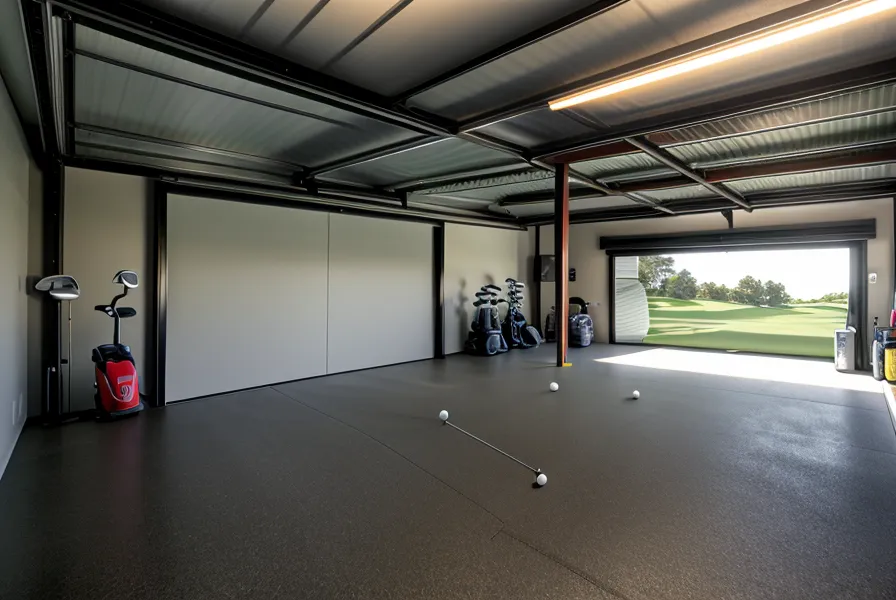
The real test came on an early April morning. It was one of those Midwest spring days where it’s 35 degrees at 7 AM but 65 by noon. In the past, I would have just skipped the practice session. But with the heater dialed in, I was out there in a t-shirt, working on my swing path. I’ve spent a lot of time reading about The Ceiling Height Reality Check and making sure I wasn't going to put a hole in the drywall, but the environment is just as important as the dimensions.
If your garage is comfortable, you actually use the simulator. It sounds obvious, but I’ve seen so many guys spend $10k on a setup only to let it sit idle because they’re too cheap to spend $300 on a decent heater. Don't be that guy. If you're struggling with joint pain like I was after my surgery, the heat isn't a luxury; it's a requirement. I actually had to swap my first mat because the cold made the backing so stiff it was hurting my wrists—you can read about that disaster in my post on The Joint-Pain Mistake.
Final Impressions on the Setup
Finishing a round at Pebble Beach while it snows outside is a surreal feeling. The SkyTrak ST MAX handles the environment perfectly now that I’ve stopped the fogging issues with the heater. I’ve noticed my data is much more consistent now that the room doesn't swing 30 degrees in an hour. If you're looking for a one-stop-shop for the whole enclosure and heating advice, the team at the Indoor Golf Shop is probably your best bet for a bundle, whereas SkyTrak Golf is where you go for the brains of the operation.
The garage conversion is finally complete (at least until 2026). My handicap is hovering around 14, my knee doesn't scream at me after a bucket of balls, and I’ve successfully turned a drafty storage space into a year-round sanctuary. Just make sure you check your circuit breaker before you plug in a 1500-watt heater and a gaming PC at the same time. I learned that lesson the hard way during a Tuesday night round, and explaining why the garage was pitch black to my wife was not my finest moment. Total cost for the heating upgrade was about $350, and it’s the best money I’ve spent since the launch monitor itself.