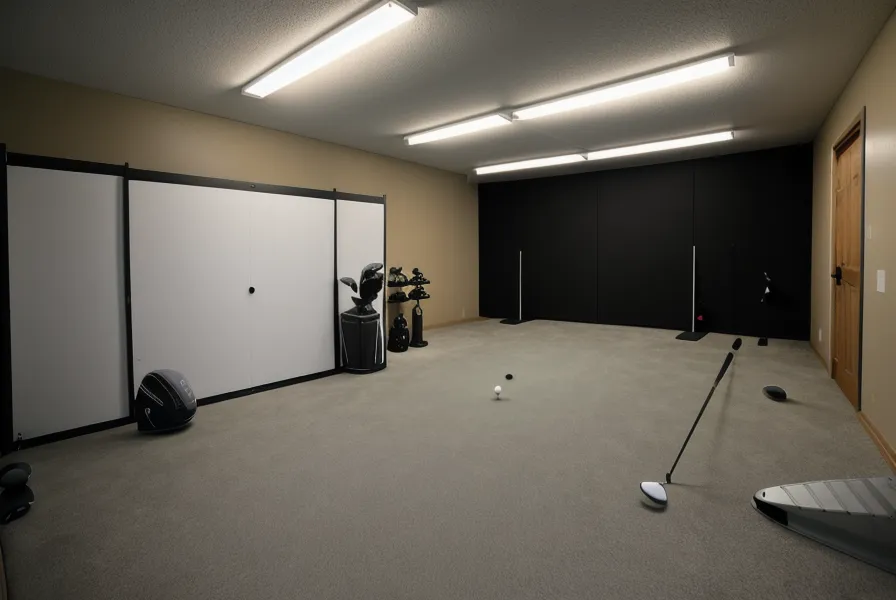
A stock driver runs about forty-five and three-quarter inches, grip to clubhead. That number matters more than most people setting up a garage golf simulator ever expect, because ceiling height stops being a spec-sheet detail the moment it turns into the thing standing between a clean swing and a cracked joist. My own DIY golf sim lives in a half-cleared two-car garage on a cul-de-sac, and the first real test wasn't the mat or the screen — it was standing under a stock nine-foot ceiling with a club in my hands and doing the swing clearance math for the first time.
Why Nine Feet Isn't What It Sounds Like
Nine feet sounds like plenty of room until the tape measure comes out. Most houses around here — Cincinnati included — are built with a standard nine-foot ceiling, which comes out to a flat 108 inches. A seventy-inch-tall guy standing flat-footed on the floor has 38 inches of clearance above his head, and a retail driver at forty-five and three-quarter inches looks like it fits with room to spare. That math holds up right up until the club stops being vertical, which is the entire premise of a golf swing.
Ceiling height is really just one variable in a bigger space equation — width for the follow-through, depth for the screen — and that full-swing math deserves its own breakdown, one I'm not trying to cram in here. A poured slab rarely sits perfectly level either; mine has enough pitch that measuring from one corner gives a different number than measuring from the hitting position itself, and the only measurement that actually matters is the one taken exactly where the ball sits, not some average of the room.
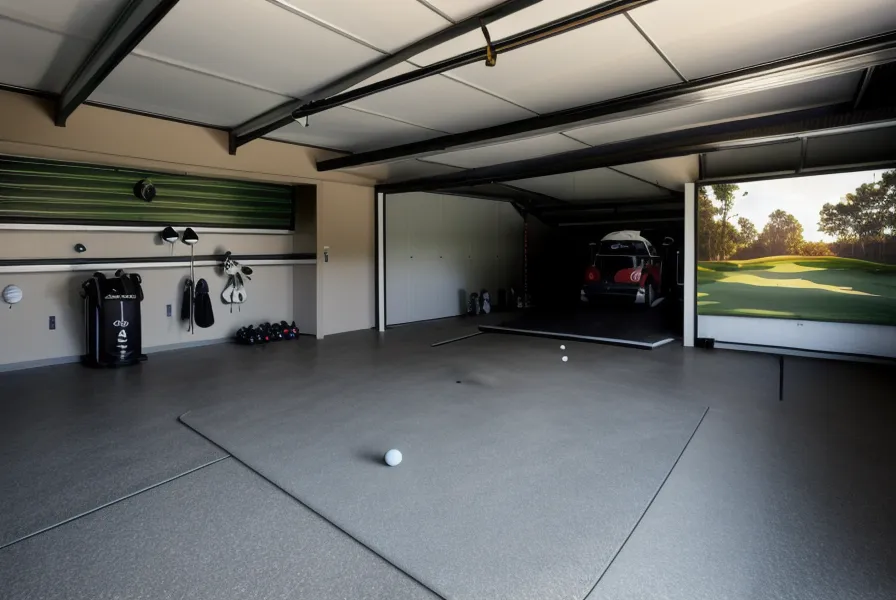
The standing math also ignores what actually happens during a swing. You're not standing on bare concrete either — a hitting mat typically adds one to three inches to your effective height, and the moment you swing a graphite shaft at ninety-plus miles an hour you stop being a static seventy-inch statue. You rise up onto your toes, you extend through impact, and the club head travels through an arc the napkin math never accounted for. A hundred and eight inches isn't a playground. It's a cage with soft edges.
How Much Swing Clearance Does a Full Driver Swing Need?
Garage door opener tracks turned out to be my actual limiting factor, not the ceiling itself. Nine-foot ceilings don't mean a nine-foot simulator space if an eight-foot garage door track hangs below it; that's an eight-foot anxiety chamber with better drywall. Sorting out the real danger zone took more than a tape measure; a subscription swing-analysis app I dropped before I'd really given it a chance, because the whole record-and-upload routine killed my motivation before it taught me anything useful about my own arc.
My neighbor Wes Quaranto stayed skeptical about the whole setup right up until he stepped into the bay for his first swing — then he ducked his head on the follow-through out of pure instinct, driver still in his hands, ball already gone. That reaction told me more about ceiling fear than any measurement could: the flinch shows up before the club ever gets close to anything.
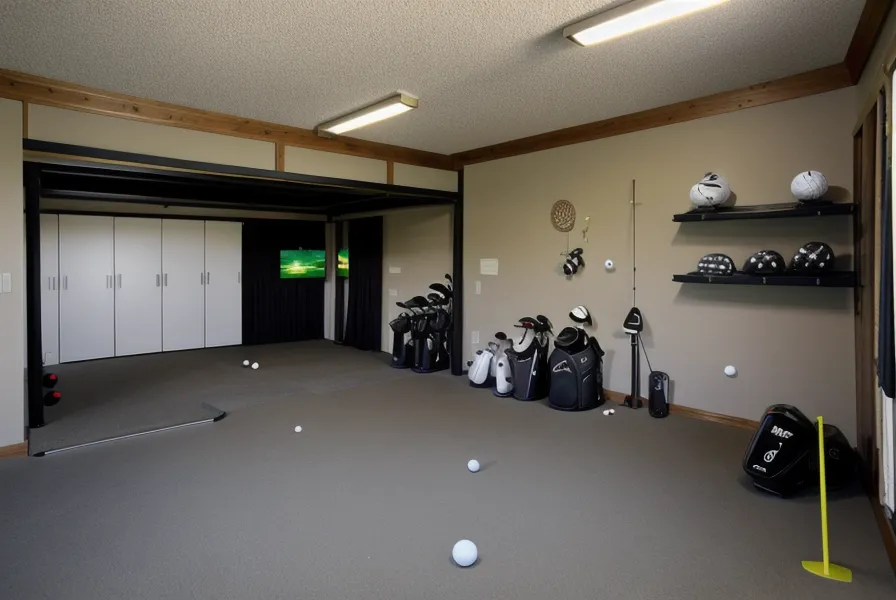
Testing swing clearance without risking a $300 driver head took some creativity. A four-dollar pool noodle taped to the end of a wedge gave me driver-length reach with a soft, foam buffer that wouldn't start a domestic incident if it clipped a joist. Forty-five minutes of slow-motion swinging later, the backswing turned out to not be the problem at all. Not even close. (Whether a hitting mat's surface actually treats a bad knee any better than another one is a separate argument, and one I've made in other posts about joint health.)
The Follow-Through Is Where the Ceiling Actually Wins
Nearly every collision risk lives in the follow-through, not the backswing, since centrifugal force peaks at release and a driver head wants to keep traveling up and out well after the ball is already gone. A high, tour-style finish in a nine-foot garage is asking for a joist to the shaft, and the flinch that follows, the involuntary duck and the pulled-in elbow, turns into a chicken-wing finish that slices the ball just as reliably as any actual swing flaw.
Swapping to a thinner mat helped more than expected, since the joint-pain mistake that cost me two returns also happened to raise me closer to the danger zone than a pillowy mat ever should. I never bothered with a full enclosure kit; an open bay works fine for a two-car space, though that's its own trade-off against side netting. A shanked iron, for what it's worth, is a containment problem for the net and side panels, not a clearance problem, and a completely different conversation from what's happening over your head.
The Hardware Factor: Fitting a Launch Monitor Into a Tight Corridor
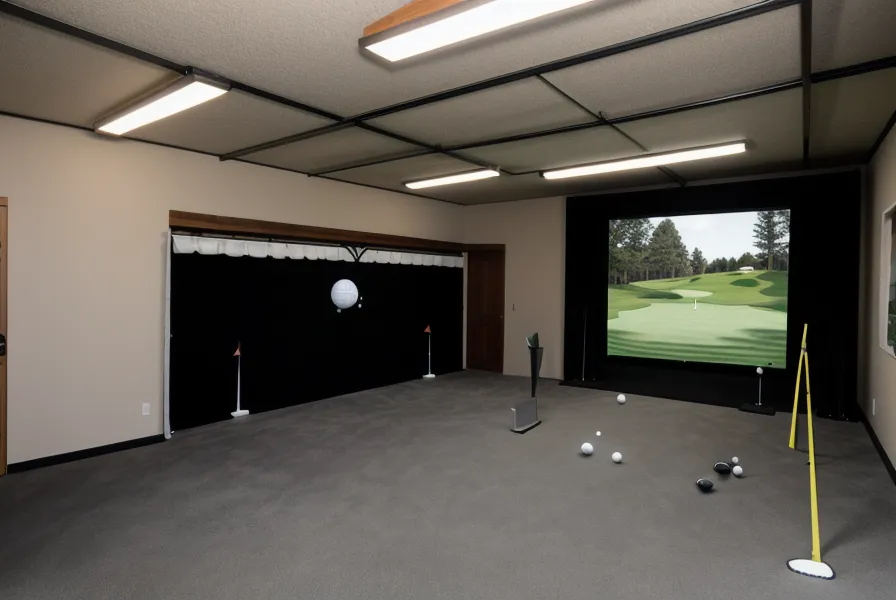
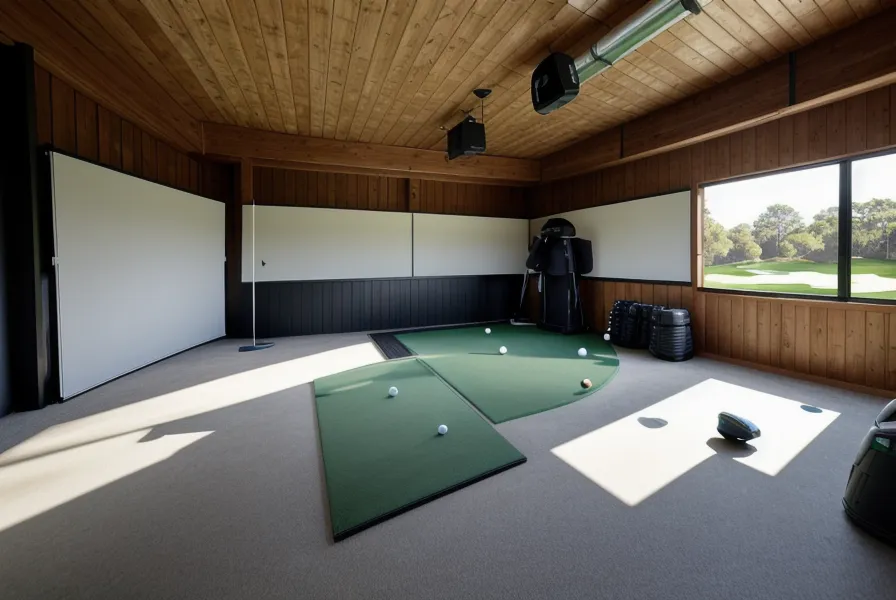
A launch monitor adds its own footprint problem on top of the ceiling math. My SkyTrak unit sits just under 6.8 inches tall, but where it needs the ball placed dictates where the mat goes, and in my garage that sweet spot landed almost exactly between two ceiling joists; six inches forward and the backswing clips one, six inches back and the follow-through finds the garage door motor. The unit tracks the usual pile of numbers, ball speed, launch angle, spin, and how reliable those photometric readings actually are is a comparison worth its own writeup, same as whether the light coming through the garage door affects a projector more than it affects a launch monitor's cameras. For anyone still deciding what to put in a corridor this tight, the SkyTrak ST Plus writeup covers why a photometric setup doesn't need ten feet of runway behind the ball the way some radar units do.
A Reader's Exact Measurement Problem
A reader named Chadwick Obiero emailed after a launch monitor comparison I wrote, with his own ceiling measurement and a question about which monitor I'd actually buy today if I were starting from zero. There's no clean formula that turns a single ceiling number into a yes-or-no answer; it depends on how steep his particular swing gets at the top, how much his mat adds to his height, and where his own garage door track happens to sit. Two weeks after I answered, he sent over a receipt photo, which is apparently just what Chadwick does once he's made up his mind.
Finding a Setup You Can Live With
By the tenth week of living with a flatter driver swing, the ceiling had mostly stopped being the story worth telling. What stuck was smaller: my wife walked past the garage on a weeknight and caught me leaning over the laptop, scrolling through ball-speed numbers just to look at them, grinning like they were box scores. She said I was actually enjoying the data part now, and she wasn't wrong.
The lesson that carries over isn't a ceiling number; it's to test the real arc your body swings, under a mat, in your shoes, with a full release, rather than trusting a tape measure held against a bare wall. Do that, and 108 inches turns from a cage into just another Tuesday-night detail in a two-car garage.