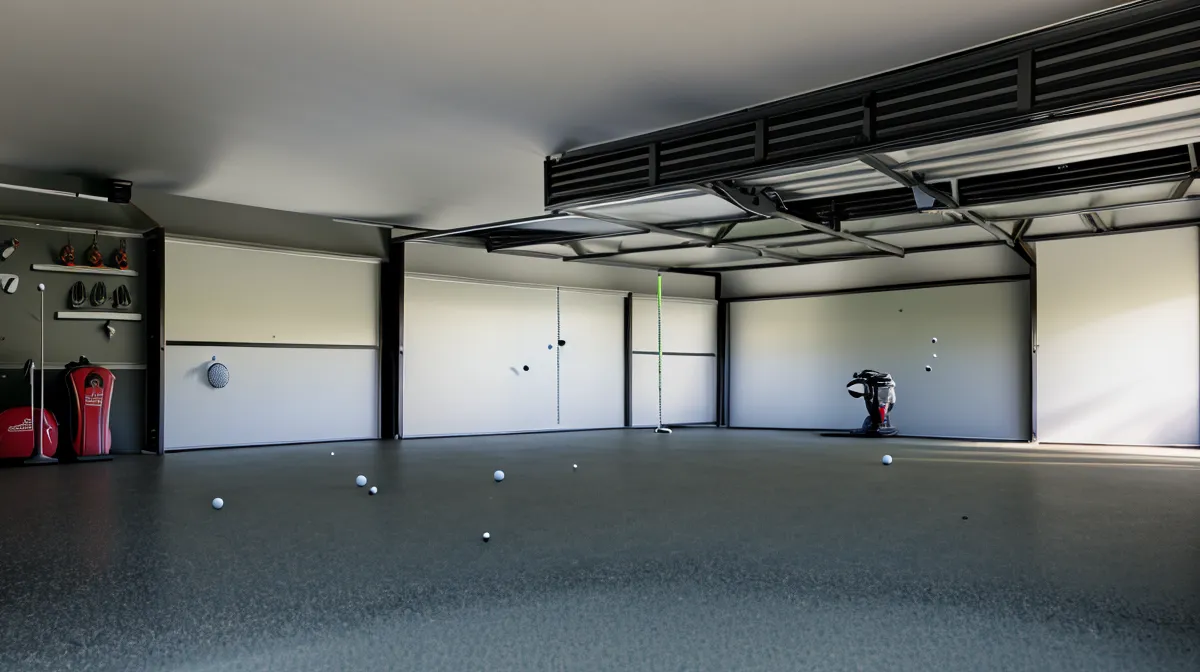
Late at night in my suburban Cincinnati garage, the only sound is the hum of a projector and the rhythmic thud of a Pro V1 hitting a heavy-duty impact screen while the rest of the neighborhood sleeps. It is a far cry from the 36 holes a weekend I used to log before my 2023 knee surgery turned my gait into something resembling a rusted folding chair. Before we get into the weeds of ball speed and launch angles, a quick heads-up: when you click through to a launch monitor or simulator product on this site and buy it, the vendor pays me a commission at no extra cost to you. I have personally bought, tested, and occasionally returned almost every piece of gear mentioned here in my own garage, so if I say a mat feels like hitting a brick, it is because my surgical knee felt it first.
By late last autumn, the reality of my recovery had set in. My days of walking five miles on undulating fairways were mostly over, replaced by a 14-handicap game that could barely handle nine holes once a month. My wife (who has officially banned any new simulator purchases until December 2026) watched as I spent the better part of 2024 clearing out half of our two-car garage to make room for what she calls 'the expensive tent.' I had pulled the trigger on a SkyTrak Golf setup because it promised a mix of photometric cameras and Doppler radar that supposedly worked in tight spaces. In a garage with a 9-foot ceiling, every inch of clearance matters when you are swinging a driver at one in the morning.
The Setup and the First Major Failure
Setting up a simulator in a garage is less like building a home theater and more like setting up a YouTube studio where someone is regularly firing projectiles at the equipment. I spent about $5,000 getting the basics right: the hitting net, the impact screen, and the projector. But the learning curve was steep. One Tuesday evening in mid-winter, I learned the hard way that you cannot skimp on the mat. I had tried to save a few bucks with a thin, generic hitting strip I found online. I took a slightly fat swing with a 54-degree wedge, and I felt a radiating 'zing' in my surgical knee that nearly sent me to the floor. It was a sharp reminder that concrete is unforgiving, and a cheap mat is just a thin layer of false hope. That mat went back the next day, and I ended up sourcing a SIGPRO from the Indoor Golf Shop, which finally gave my joints the cushion they needed.
The sensory experience of the garage is something the YouTube tours don't quite capture. There is a specific, sharp 'thwack' of a clean iron shot echoing off the concrete garage walls before being muffled by the polyester impact screen. It sounds like a gunshot in the confined space, but the screen absorbs the energy like a heavy velvet curtain. By early spring, I had dialed in the SkyTrak software to the point where I was playing 18 holes at Pebble Beach in my gym shorts while the Ohio winter raged outside. There is a strange, humid heat that builds up in a closed two-car garage after forty-five minutes of vigorous driver swings, even when it is freezing outside. I’d finish a session with my heart racing and the windows fogged up, feeling more like I’d just finished a CrossFit class than a round of golf.
The Data and the Apartment Dilemma
As an IT guy, I live for the data. Seeing my 7-iron carry hover around 155 yards with a 14-degree launch angle gave me a level of feedback my 14-handicap brain never had on a real range. However, I recently had a buddy over who lives in a third-floor apartment downtown, and he was ready to buy my exact setup. I had to talk him down. Standard advice for indoor golf usually prioritizes high-end floor-mounted launch monitors like mine, but those units transmit a massive amount of vibration noise through floorboards and ceilings. In a garage on a concrete slab, the 'thump' is just a noise. In a multi-story apartment building, that same thump is a tectonic event for the neighbors downstairs. If you aren't on the ground floor, you aren't just buying a simulator; you're buying an eviction notice unless you invest in a floating subfloor that costs as much as the monitor itself.
After about six months of regular use, I started looking at the peripheral gear that makes the experience feel 'real.' While I can't buy new 'SIM' tech per the spousal treaty, I did manage to sneak in a SWAG Golf putter made of 303 stainless steel. Putting on a simulator is always a bit wonky—you're basically rolling a ball into a screen three feet away—but having a tour-spec milled face helps with the speed control when the software is being finicky. I also looked into the Alphard Golf Cybercart for my rare outdoor rounds, though I noticed the battery cycle rating is a 500-cycle threshold, which is something to watch if you're a heavy user. Most of my gear comes from Golf Direct Now these days because their price matching is solid, even if their sim-specific inventory is a bit thinner than the dedicated shops.
Reflections from the Garage Floor
There is a weird sense of guilt that creeps in when I realize I'm more excited for my Tuesday night virtual rounds than I ever was for my actual club championship. Maybe it's the lack of a four-hour time commitment, or maybe it's just the fact that I can play Pebble Beach without my knee giving out on the 4th hole. Staring at the loading screen, I’ve realized that the $5,000 I spent wasn’t just for the gear; it was for the ability to keep playing a game that my body tried to take away from me. The 9-foot ceiling is just enough to clear my driver, and the SkyTrak catches about 98% of my shots without a hiccup. It isn't perfect, but for a guy in suburban Cincinnati just trying to stay in the game, it is more than enough.
If you're still on the fence about your own build, start with the space requirements and the floor situation. If you're recovering from an injury like I am, don't even think about a cheap mat—your joints will thank you for the $400 upgrade. You can find more of my trial-and-error logs on reclaiming weekend rounds after injury or check out my SkyTrak vs Garmin comparison if you're still choosing your brain for the operation. Just remember to measure that ceiling height twice, or you'll be explaining a hole in the drywall to your wife before the first virtual tee time.