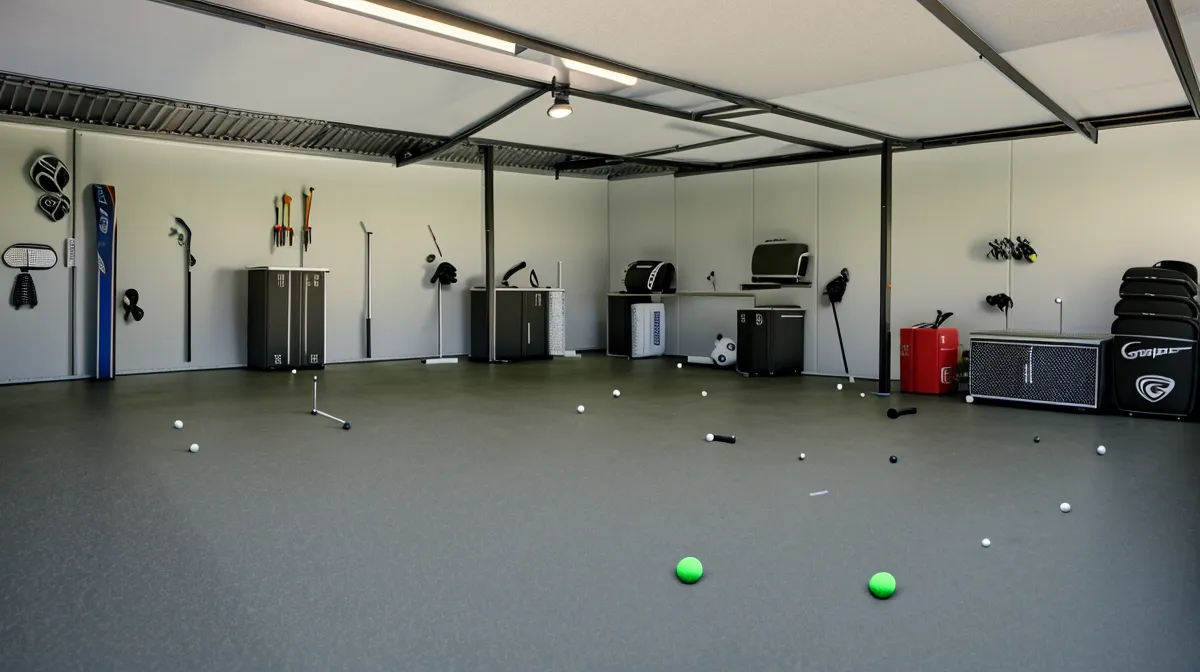
How much ceiling does a full driver swing actually need in a garage golf simulator, and why does that number get repeated like a building code nobody's allowed to question?
Ten feet is the figure that shows up in nearly every build thread and YouTube walkthrough, and it isn't wrong exactly, it's just answering a narrower question than the one that actually matters. A full-driver swing in an enclosed bay needs a minimum of 9 feet of ceiling height at the ball position, 9 feet of bay width, and 15 feet of depth from ball to screen. Come up short on any one of those three and the fix isn't a bigger garage, it's choking down on that club or switching to a limited-arc training aid for it.
I've watched plenty of golfers chase the ceiling number and ignore the other two, then wonder why the driver still feels cramped once they're actually playing a round of Pebble Beach instead of just standing in the bay admiring the projector.
Nine Feet Is a Swing-Clearance Floor, Not a Comfortable Number
Nine feet sounds generous until a standard 45.5-inch driver reaches the top of a backswing. That figure is the minimum survivable ceiling, not a comfortable one, and manufacturers list it because it's the smallest number that's technically true, not because it feels good to swing inside.
I still remember the first time I stood over a 3-wood in the sim, lined up on the fairway at Augusta National's thirteenth hole, and actually let the club go instead of babying it, the ball came off dead center and split the fairway, and for a second I forgot I was standing in a garage at all. That's the moment nine feet of ceiling and nine feet of width are supposed to protect: not comfort, but the second a golfer actually commits to the shot.
Simulator Dimensions: Width and Depth Matter As Much As Height
Width gets ignored more than height because it's harder to picture standing still. A backswing and follow-through travel sideways as much as they go up, and a full swing needs roughly nine feet of lateral room on top of the vertical clearance, not instead of it.
Depth is the dimension that gets cut first, usually because garages aren't fifteen feet deep once a water heater, a workbench, or a second car gets factored in. Fifteen feet from ball position to screen isn't an arbitrary studio spec, it's the room a driver's swing path needs so the club head and the ball clear the screen without anyone flinching. That room also has to account for the standard golf ball diameter of 1.68 inches, tiny as it sounds, leaving the face at speeds that make a flinch a pretty reasonable reaction.
Why a Level-Looking Garage Floor Still Throws Off a Swing
Concrete floors look flat and rarely are. Most garage slabs carry a slight pitch toward the door for drainage, invisible standing up and very noticeable once a mat starts sliding half an inch mid-downswing.
A neighbor of mine treats his Saturday mornings the way I used to, out playing disc golf at Winton Woods while I'm on my knees checking a slab with a level (he thinks the whole simulator project is a little much, though he's never turned down a beer while I hit balls). A walk on the Little Miami Scenic Trail near Milford does more for my knee these days than eighteen holes ever did, but it won't tell you a thing about whether your garage floor is level.
Shimming a mat until it's trustworthy is its own small project, more about compensating for that drainage pitch than anything to do with swing mechanics, and it's really a separate rabbit hole from clearance entirely.
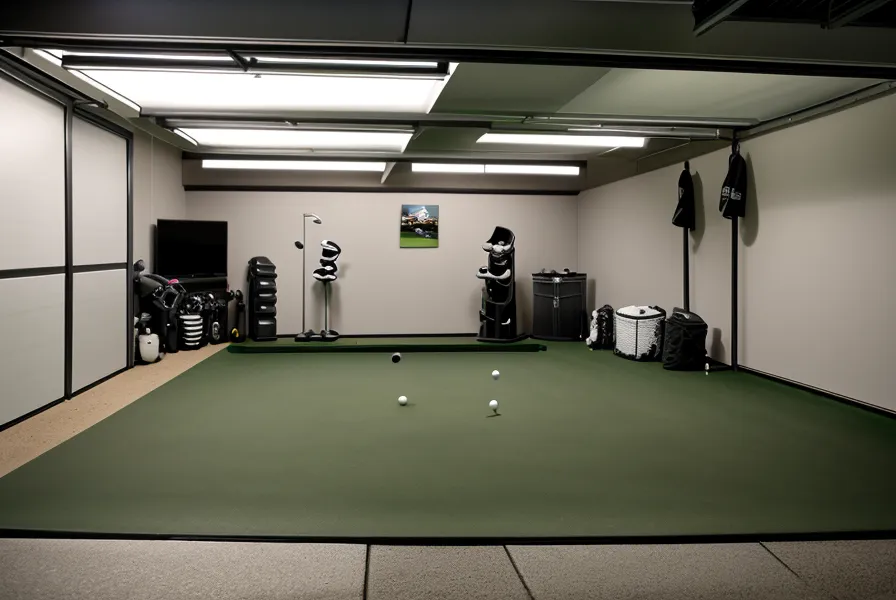
The Footing Problem: What a Bad Mat Does to Your Weight Shift
Footing is where a cheap fix actually backfires. A hardware-store rubber anti-fatigue mat seemed like an easy answer for stance comfort, the kind sold for standing at a workbench all day, and it compressed unevenly under my back foot on every downswing. Weight shift went sideways right along with it, and it took a few sessions of oddly inconsistent contact before the mat itself, not the swing, turned out to be the problem. A cheap fix. An expensive lesson.
A proper hitting mat is closer to a yoga mat than a workbench pad in terms of what it's actually doing, giving even, consistent feedback under the joints through impact rather than just cushioning the ground. That's a different job than fatigue relief, and it's worth treating as its own purchase instead of assuming any thick rubber square will do.
One detail from an earlier piece on accessories for a better garage practice experience matters even more here — a properly weighted mat that doesn't creep during an aggressive swing, especially once it's shifted off-center to protect the swing path instead of centered for looks.
Screens, Light, and the Rest of the Bay
Screens take a beating that most buyers underestimate going in. How long an impact screen holds up under repeated contact from an actual driver swing is a subject on its own, worth more than a passing mention here, but it's tied directly to how much depth and containment the bay gives the ball before impact.
An open bay without side netting turns every mishit into a small emergency, and that's really a containment question separate from clearance — how a stray shot off the toe gets caught before it finds a window or a car door deserves its own conversation.
Whether to build a full enclosure or work in an open bay changes a lot of these numbers too, since an enclosure kit adds its own frame depth and width on top of the swing clearance a golfer needs, and that trade-off deserves its own comparison rather than a footnote here.
Light matters more than most builds account for, since a bright projector image needs real contrast to read clean, and a garage with a window or an open door washes that out fast. The projector fan on mine picks up a noticeably louder note whenever the space heats up past a comfortable temperature, a small reminder that none of this gear loves a hot, uninsulated room.
A launch monitor is doing something like what a kitchen scale does on a counter: it just measures whatever's put in front of it, and if it's placed wrong or blocked at a bad angle, the reading lies to you with total confidence. That's the actual argument for camera-based units over the radar kind, and it's the case I laid out in why I chose the SkyTrak launch monitor for my garage setup — how accurate the ball-flight numbers turn out to be depends more on placement than on the spec sheet. Which specific metrics matter most for a mid-handicap swing is a longer conversation than fits here, but it starts well before ceiling height ever enters the picture.
Measure Before You Order Anything
Nine feet of height, nine feet of width, and fifteen feet of depth is the actual checklist worth running before any money gets spent on a launch monitor, a net, or a screen. Stand in the space with the longest club planned for the setup, hold it at the top of the backswing and again at the end of the follow-through, and note anywhere a shoulder tenses up about clearance. That tension is data, not nerves.
Anyone dealing with a tight ceiling on top of everything else can check a separate guide on how to mount a golf simulator projector in a low ceiling garage, since mounting hardware eats into that nine-foot number fast if it's planned as an afterthought.
None of this needs a bigger garage or a bigger budget to fix in a DIY home setup, just an honest tape measure and a willingness to swap the driver for a shorter club on the days the bay doesn't have the room for it. A simulator built to the space it actually has beats one squeezed into a number copied off a forum, every time.