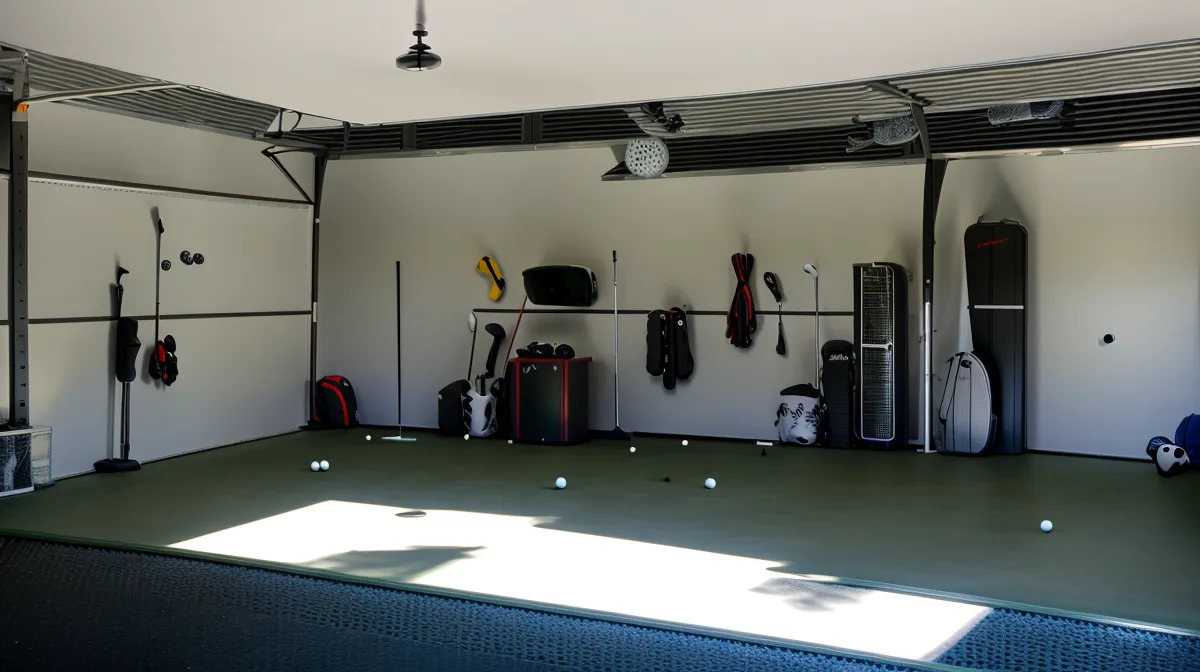
Four balls. One cluster on the screen. Eight yards between the widest two shots — the tightest driver dispersion I'd ever produced, all sitting inside that circle on what my launch monitor called the eighteenth green at Pebble Beach. Quick disclosure up front: a few links below are affiliate links, and if you buy through one I earn a small commission at no extra cost to you — every piece of gear mentioned here got bought, tested, and either kept or shipped back on my own dime first. Getting to that dispersion cloud took a full mid-range garage golf, home-simulator build, not a pro shop budget, and the SkyTrak Golf unit sitting at the center of it is the reason a moment like that turns into a number instead of just a feeling. Pebble Beach stopped being walkable in any real sense after knee surgery, but it turns out you don't need real grass to make a dispersion pattern like that mean something.
The Guy Who Could Barely Walk Nine Holes vs. the Garage Golf Guy Hitting Pebble Beach on a Tuesday
Before any of this gear showed up in the driveway, I was someone who played something like 36 holes most weekends and then, after a 2023 knee surgery, was lucky to limp through nine holes once a month. My handicap crept up right along with the couch time, and most of my golf consumption turned into 2 AM YouTube videos of other people's simulator builds instead of actual golf. These days a free Saturday morning is just as likely to be a grocery run out to Jungle Jim's in Fairfield as anything golf-related, while my neighbor is still out the door early chasing discs through Winton Woods the way he always has. That gap — someone who barely lost any outdoor golf access next to someone who lost almost all of it — is the actual case for clearing out half of a two-car garage for a launch monitor instead of just buying a better couch.

Camera or Radar: Does It Even Matter in an Eight-Foot Bay?
Every mid-range launch monitor conversation eventually turns into a fight between photometric cameras and Doppler radar, and SkyTrak's camera-based system usually sits at the center of it. That's a deeper rabbit hole than this comparison needs, and the actual accuracy tradeoffs between camera systems and Doppler radar units are better covered somewhere that isn't also trying to cover mats, screens, and course-day gear in the same breath. What matters here is simpler: whichever system you pick has to work with the ball flight distance you actually have, and mine is short. I did the tape-measure math on ceiling clearance before buying anything, mostly out of fear that a full driver swing on the follow-through was going to introduce itself to a joist. Garage dimensions before you commit to a full-swing setup are their own comparison, and not one I'm solving in a couple of sentences here.
The Mat That Got Returned and the One That Didn't
Case in point on gear that looks fine in a store aisle and falls apart under an actual golf swing: early on I grabbed a rubber anti-fatigue mat from the hardware store, the kind sold for standing at a workbench all day, and put it under my stance foot. It compressed unevenly the moment real swing weight hit it. My weight shift went sideways every time I loaded into my back foot. Every single rep. The whole thing felt like standing on a trampoline instead of a fairway, so back it went. What replaced it came through the Indoor Golf Shop, and the difference is closer to swapping a bath mat for actual gym flooring than anything golf-specific — the feedback under a wedge shot changed completely once the surface stopped compressing under my trail foot. There's a longer piece to be written about what a mat's surface actually does to joint feedback over a full session; this isn't that piece. Mine's simpler: the mat that compressed under my weight versus the one that didn't, and only one of them earned a permanent spot in the garage. There's also a specific smell in the garage before a session starts now — mat rubber warming up, with a faint edge of old motor oil drifting down from somewhere near the door track — that's become shorthand in my head for practice time instead of chore time.
The Screen That Sounded Like a Gunshot, and What Fixed It
My first impact screen turned every wedge shot into something that sounded like a gunshot going off in an enclosed space — loud enough that my wife started appearing in the garage doorway, arms crossed, reminding me of the no-new-purchases pact she'd already gotten out of me through the end of 2026. Fixed. Mostly. I moved to a heavier, multi-layer screen material, and the difference is roughly the gap between a bedsheet stretched over a frame and an actual projection screen built to take a hit — one absorbs the impact, the other just complains about it loudly. I put together the garage golfer's guide to impact screens separately for anyone chasing the deeper version of this decision, but the short version here is that the heavier screen won the durability question, and the loud one didn't survive the goodwill test in my own house.

Garage Nights vs. Course Days: Where the Rest of the Build Budget Goes
Not everything in this budget lives inside the garage. Tuesday and Thursday nights are simulator nights, but the once-a-month real round still happens, and the gear splits fairly cleanly along that line. For actual course days, I've been eyeing the Alphard Golf Cybercart to save the knee from pushing a manual trolley around eighteen real holes, and separately I upgraded my putter to a SWAG Golf model milled from stainless steel, mostly because rolling a cheap mallet putter across a foam practice mat had started to feel like using a plastic fork on a steak dinner. For the smaller stuff — nets, extra balls, the odds and ends that don't justify a specialist retailer — Golf Direct Now has covered most of it, and I wrote up the actual best golf simulator side nets setup separately after nearly putting a ball through the water heater not long after this whole thing went live. Containing a stray shank inside a finished garage bay is genuinely its own decision tree — net placement, screen coverage, what's actually sitting behind the mat — and it deserves its own answer rather than a paragraph folded into a launch monitor comparison. None of this happens for free, either: the honest running total sits close to five grand once you count the launch monitor, the mat, the screen, and the accessories that didn't make the cut, and where exactly that money should go first is a longer breakdown than fits inside this one.
What This Comparison Isn't Trying to Cover
A few things this comparison deliberately skips, mostly because each one deserves its own real estate instead of a rushed paragraph here. Whether a full enclosure kit beats an open-bay setup is a genuine debate once you start weighing airflow against net rebound, and I'm not settling it in this piece. Projector contrast under ambient garage light is its own separate rabbit hole, and so is whether a poured concrete slab needs leveling before a mat goes down on top of it. On the software side, there's a separate discussion about what a simulator engine does to a PC's render load, how a launch monitor's calibration can drift over a long session, and which core metrics actually matter for a mid handicapper instead of a scratch player. All of that lives in its own comparison, not this one.
So Which One Do You Actually Buy?
Boiled down, the comparison that actually matters for anyone reading this with a spare garage bay is simpler than camera versus radar or one mat brand versus another: buy the launch monitor first if the honest goal is more reps and real data on a swing that's already broken in some specific way, and hold off on the mat, the screen, and the accessories until the core numbers have proven themselves worth building around. Buy the course-day gear first instead if the real bottleneck is getting out to play at all, knee and schedule allowing, because a push cart or a better putter solves a completely different problem than a garage build ever will. My own money went to the launch monitor first for one plain reason: the garage was available every single night, and the actual course wasn't.
If a mid-range garage setup is the direction you're already leaning, the SkyTrak Golf unit is still the piece I'd point a friend toward first — everything else on this list, kept or returned, only mattered because that launch monitor gave me a real number to react to in the first place.