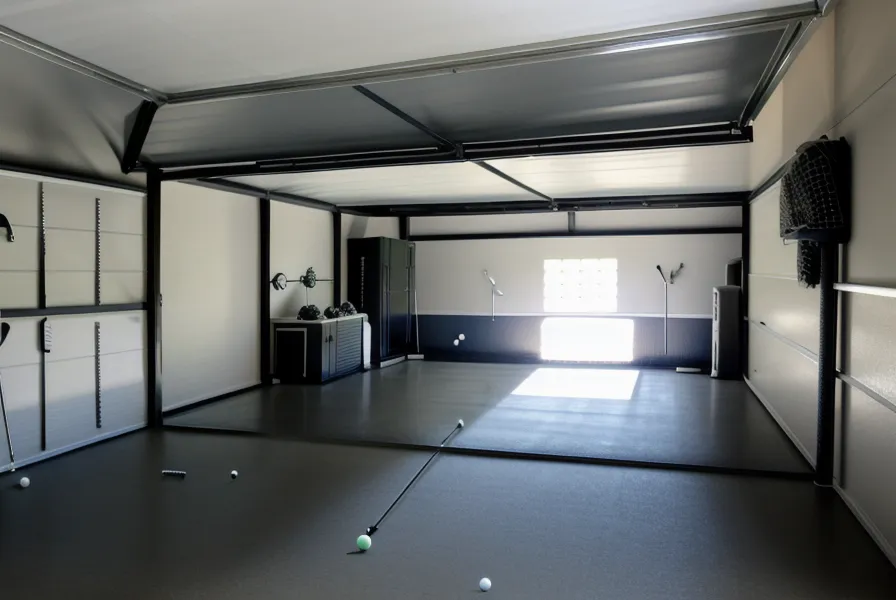
The difference between a garage golf simulator that gets played twice a week and one that turns into an expensive laundry rack matters. I've put enough into this build to have bought a decent used car instead, and I still ask myself that question every time a box shows up on the porch. Indoor golf sounds like an easy trade for lost course time, but a real home golf cost breakdown never fits inside the first receipt. The SkyTrak setup is just where the spending starts (my wife, for the record, has frozen all new simulator purchases through December 2026).
What Does a Garage Golf Simulator Actually Cost in 2026?
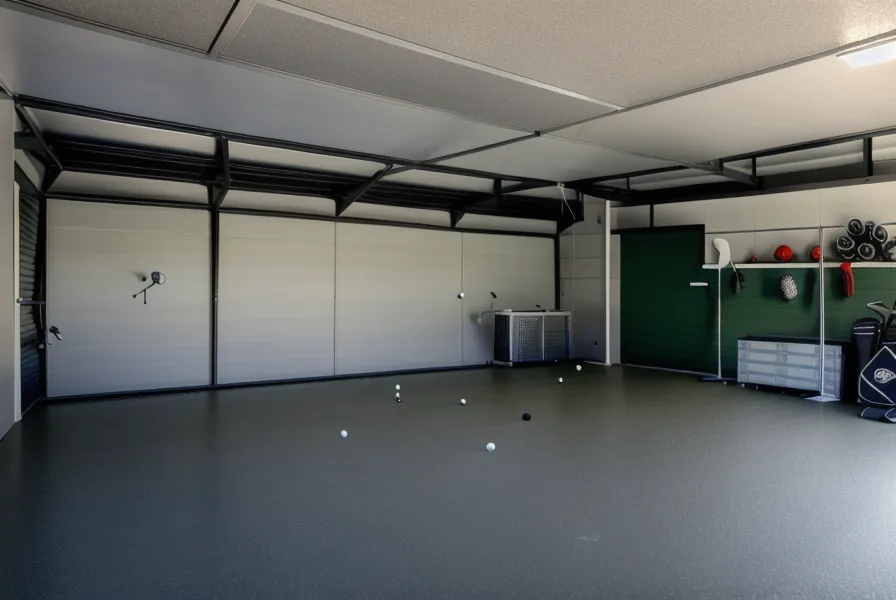
Total spend on this project sits close to five thousand dollars, and that number includes every mulligan along the way. I told myself under three grand would cover it back in spring 2024, which is the kind of promise a spreadsheet laughs at. The monitor is maybe forty percent of that; the rest gets eaten by the mat, the impact screen, a netting setup wide enough to actually contain a mishit golf ball at full swing speed, and enough concrete-floor prep to keep the mat from sliding mid-swing. How long a given impact screen actually holds up under real swings is its own topic I've gone deep on separately, so I'll leave it there for now. Whether you build inside a full enclosure or just hang a screen in an open bay changes the math more than any single piece of gear does, and it's worth pricing both before you buy lumber. Ambient light control — foam panels over the garage door windows, mostly — adds another line item that never shows up in anyone's YouTube parts list. None of it approaches the forty-thousand-dollar showroom builds you see online, but none of it is the three-grand budget build either.
The SkyTrak Setup: What It Actually Buys You
My monitor cost about two thousand bucks, and comparing it to other rigs is a little like comparing kitchen scales — the good ones agree with each other closely enough that arguing over the third decimal isn't where anyone should spend their attention. I've written elsewhere about why I trust the ball-flight numbers this thing spits out shot after shot, so I won't rehash the sensor debate here. What matters for a cost conversation is that a reliable mid-tier option let me stop shopping and start playing, and that's worth more than the spec sheet suggests.
Do You Need a Pro-Level Monitor, or Just a Reliable One?
Spin rate, launch angle, clubhead speed — those are the core numbers every monitor promises, and chasing the third decimal point on any of them is a rabbit hole better covered somewhere else. Conrad, a colleague from the IT team who built his own basement rig on a noticeably tighter budget, still needles me about how much I overpaid for headroom I don't use (he's quietly proud of every dollar he didn't spend, and he's not wrong to be). What actually settled the accuracy question for me came on an ordinary weeknight: I stood over a 7-iron, the number came back 156, and that's the exact yardage marked on the scorecard at Lunken Airport Golf Course, out in the East End, where I used to play most of my rounds. That kind of agreement matters more than a monitor's marketing copy ever will.
Ceiling Height Kills More Builds Than Budget Does
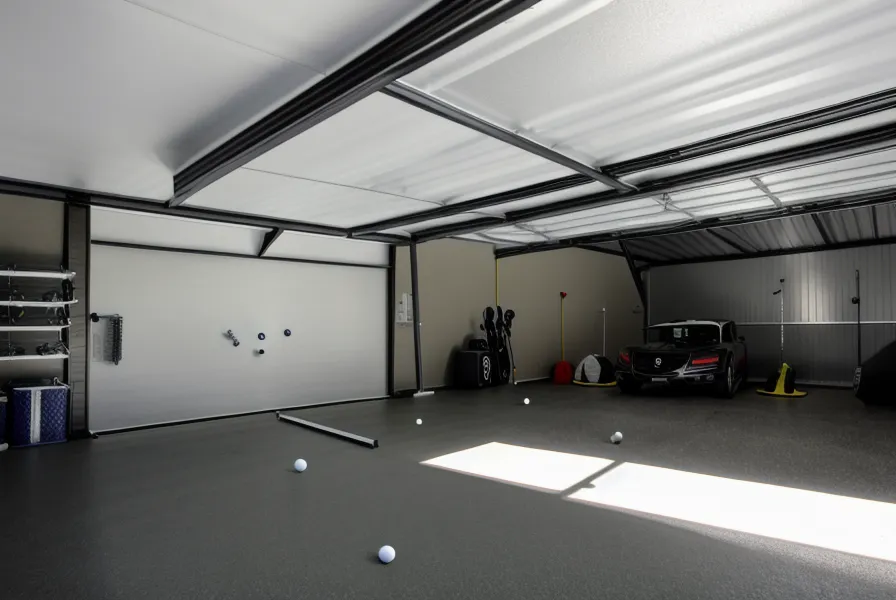
Swing clearance is the cost nobody budgets for because it never shows up on an invoice. From where I stand to the back wall of the garage, I've got right around nineteen feet to work with — enough room that a full driver swing doesn't feel like it's fighting the walls. How much room a given ceiling height actually buys a full swing is a detailed topic on its own, and I'd point you toward the recommended simulator ceiling height of 9 feet I worked through separately rather than summarize it badly here. Screen geometry matters just as much: get the aspect ratio wrong relative to your projector's native output and you'll fight a warped, egg-shaped image no matter how good the mat or monitor are. Nate, a fellow builder I know from the Cincinnati Golf Simulator Discord, asks about ceiling clearance in nearly every conversation we have — more than mat feel, more than screen brand, more than anything else. He's not wrong to fixate on it: a low ceiling shortens your swing before you notice it happening, and that's a harder habit to unlearn than a bad mat is to replace.
Picking a Hitting Mat That Won't Wreck Your Knees
Knee surgery changes what you're willing to tolerate from a mat, and I learned that the expensive way over three different attempts. One of the early ones was a garage-sale putting mat that looked fine in the driveway. Two weeks on concrete, curled at both ends. Back to square one, because cheap foam backing just isn't built for a slab. Comparing a hitting mat to a yoga mat isn't far off: thickness alone doesn't tell you how it'll feel after fifty swings, and the fiber system underneath matters more than the price tag suggests. I've written in more detail about the joint-pain mistake I made with my first hitting mat, so I'll spare the full story here — the short version is that a mat letting the clubhead move through the surface instead of bouncing off it is the difference between a normal Tuesday and a sore elbow for a week. Whether a given surface transmits shock back into your joints or absorbs it is worth testing in person before you buy, not something you can judge from a product photo.
The Five-Thousand-Dollar Verdict
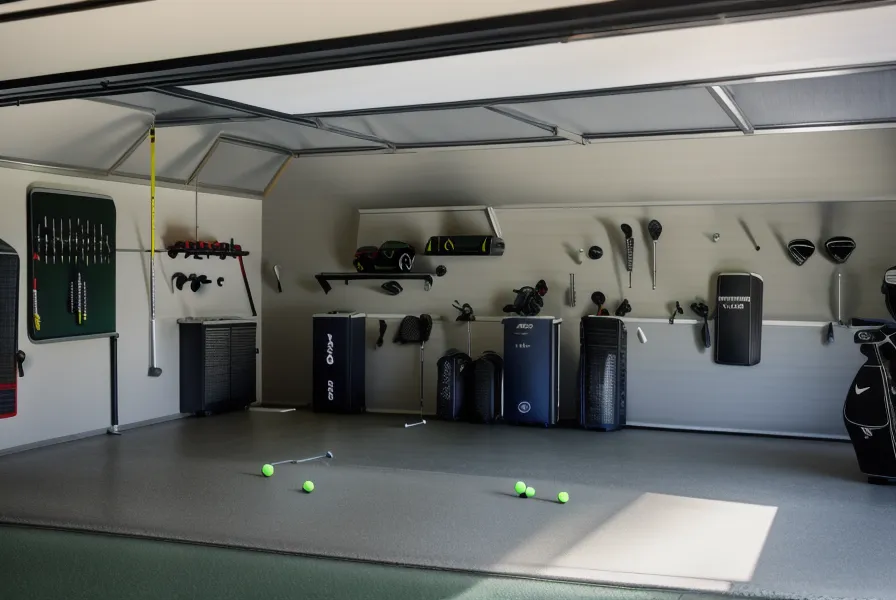
Close to five thousand dollars can buy something worth keeping or be just an expensive way to avoid driving to a course. For me the answer isn't the sensor readout or the enclosure. It's that I play golf on a Tuesday night instead of not playing at all, and that trade is worth more than any single receipt in the stack. The real advice, if you're pricing your own build, is to budget the mat and the screen before you obsess over the monitor: a twenty-dollar roll of Velcro solved more of my frustration than the next big expense of sensor upgrade would have. Two of the pieces I bought went back in their boxes and shipped out again, and neither of those returns is one I regret — better to find out a piece doesn't work in month one than to keep pretending it does. Check your ceiling height before you buy anything else. Everything downstream of that number is negotiable; that one isn't.