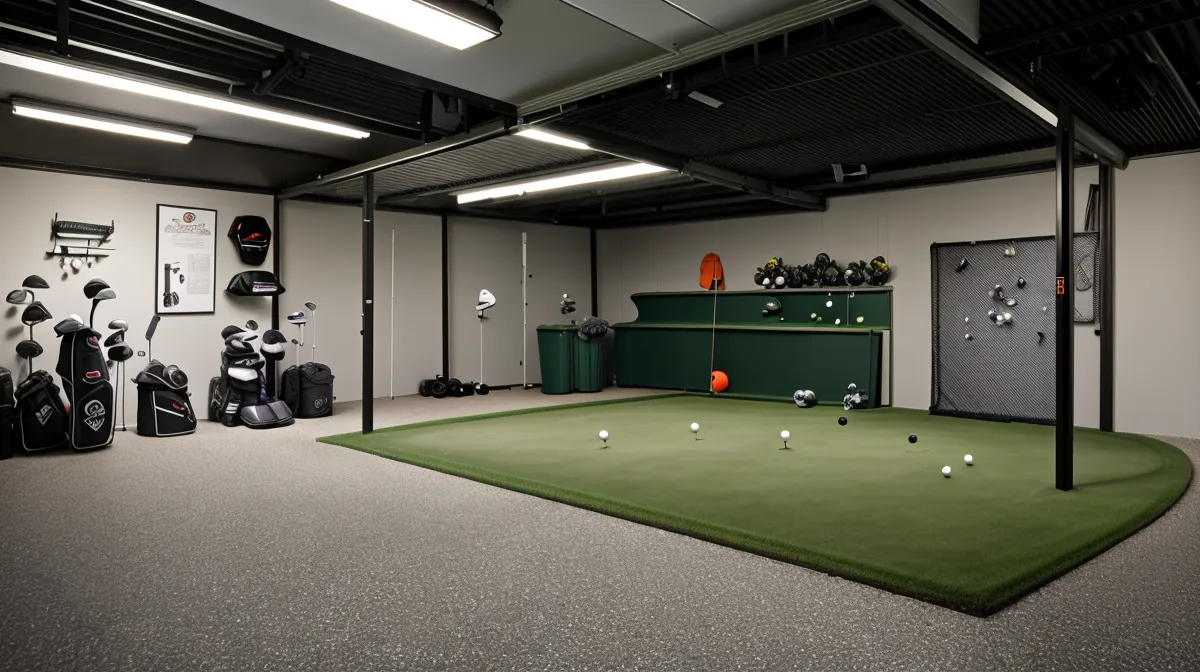
A cheap pop-up net will stop a mis-hit chip that dribbles off the mat. It won't stop a full-speed shank headed sideways into a stud wall, and confusing those two jobs is exactly what turns a home golf build into a repair bill you didn't budget for on top of the roughly $5,000 already sitting in that garage bay. That's the myth worth correcting before anyone else clears out a bay for a real shot at simulator safety: side protection isn't an accessory sold next to your SkyTrak setup, it's the piece of the build that decides whether a bad swing costs a Saturday afternoon with a putty knife or nothing at all.
Two sentences on the money side before the mesh talk: buying through a link below sends a small commission my way at no extra cost to you, and everything mentioned here has actually taken a hit — sometimes literally — inside my own garage bay.
Since clearing half of the family two-car garage for a SkyTrak Golf setup, enough mid-handicap misses have gone through that space to show exactly where the real risk lives. Driver ball speed for a player like me sits somewhere in the 130-150 mph range — one of the core numbers any launch monitor reports, along with launch angle and spin, and the camera-and-radar combo in mine has been consistent enough to actually plan a swing around. Drywall offers almost no resistance to that kind of impact, a clean strike going through half-inch gypsum board about as easily as a fastball through a window screen. Most first-time builders study the ceiling height reality check before they ever swing a club, which is smart, but width is where the actual danger lives, and almost nobody budgets for it.
That gap between ceiling math and side-wall risk is exactly why side netting options from the Indoor Golf Shop exist as their own category in the first place — they're built assuming the ball is coming in from an angle, not just straight ahead down the middle.
The Simulator Safety Myth About Impact Screens
Picture the standard setup: an impact screen or hitting net dead ahead, camera and mat underneath, and the assumption that the space is now covered. It isn't. Walk into any finished two-car bay after a full season of use and the marks on the wall tell a different story — the balls that actually connect with drywall are rarely the ones headed straight at the screen. A shank off the hosel, a heel strike, a pull that starts left and never comes back — those are the shots that end a session with a hole in the wall instead of a number on the launch monitor.
Marketing sells the screen, not the side wall, which is backwards: the net doing the real work is the one running down the side of the bay, not the one everyone stares at while lining up the shot. How long an impact screen itself holds up under direct hits is a separate question with its own answer — a side net does an entirely different job, catching what never reaches the screen in the first place.
The Real Danger Zone in a Two-Car Bay
My own bay runs about 19 feet from ball position to the back wall, poured concrete floor still ghosting a faint oil stain in the far-left corner from whatever the previous owner parked there, a single 8-foot LED shop fixture mounted overhead, and a working garage door on the right side sealed along the bottom with rubber weatherstripping. That garage door is the expensive target in the room — replacing a track or an opener costs far more than a drywall patch — and it sits close enough to the swing path that an off-line shot reaches it before it ever reaches the back wall. Anyone sizing up their own space for stray-shot containment should measure sideways before measuring up, since ceiling height only governs how high a backswing can extend, not how far a hook travels off line.
Ambient light plays into this more than people expect. A single shop fixture is plenty for the mat and hitting zone directly under it, but it leaves the side walls dim, which is exactly where dark mesh disappears right before a mis-hit heads that direction. A lighter-colored net, or one with reflective binding along the frame, earns its keep in a garage running on one light source — the same way a white cutting board shows a knife nick that a black one hides completely.
Why Most Side Nets Aren't Rated for a 90-Degree Hit
Before any of this netting research started, there was already a swing-analysis app sitting unused on my phone — a subscription I paid for and dropped after six days once uploading video after every single session got old fast. That history made shopping for side protection feel like round two of the same mistake: spend on the exciting part, skip the boring part, regret it later. Taking the mesh-rating question seriously instead of waving it off as marketing fine print came out of that same lesson, not out of any particular love for reading tension specs.
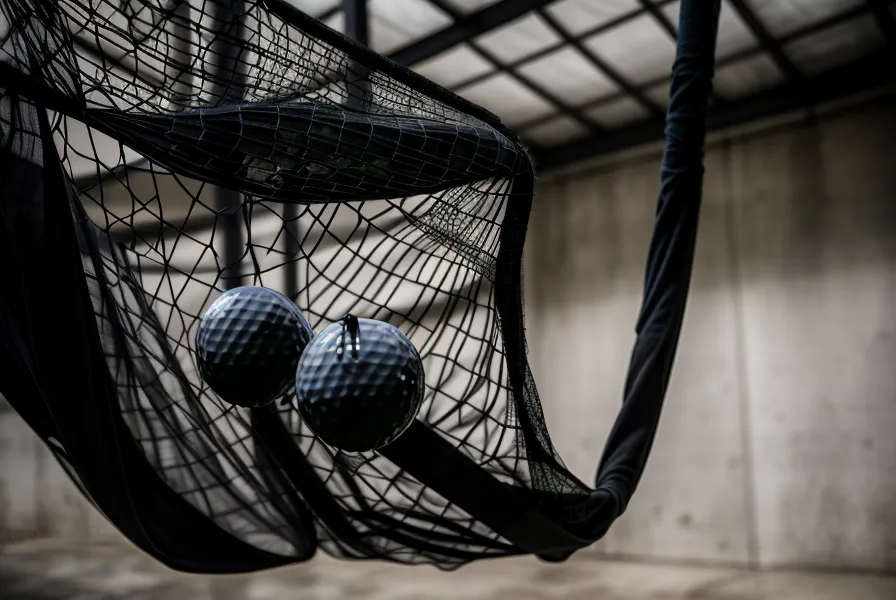
This is the part most reviews skip: mesh weight and tension rating matter more than whether a net looks tidy in a product photo. A panel built to catch a ball rolling in at a shallow angle from ten feet away is not the same product as one built to absorb a full swing-speed strike at close range and a steep angle, and plenty of budget options on the market are only ever tested for the first scenario. High-tension polyester, properly framed and anchored, kills the ball's momentum on contact instead of letting it wrap around loose mesh and keep traveling toward whatever sits behind it — what the mat underneath does for aging knees and joints is its own separate consideration, worth researching on its own before assuming any pad will do the job.
Frame-Mounted, Tension-Based, or Full Enclosure?
There's a real tradeoff once you move past the bargain bin: permanent frame-mounted netting gives better impact absorption but takes a more involved install, while portable tension-based side nets go up and down fast but ask more of the floor they're anchored to. If the right flooring for your garage concrete is already sorted, anchoring a frame straight into the slab keeps the netting taut for years instead of months. A loose net, tension-based or not, lets the ball wrap around the mesh and still reach the wall behind it — tension is the entire point of the product, not an afterthought stapled onto the packaging.
A full enclosure, like the packages built around the Indoor Golf Shop catalog, folds that decision in for you: netting, screen, and frame arrive as one rated system instead of parts you're matching up on your own. That's the enclosure-versus-open-bay call every garage builder eventually makes — an open bay costs less and fits an oddly shaped space better, while a full enclosure trades some floor space for a barrier tested as a single unit instead of a stack of separately rated pieces.
Where I'd Actually Spend the Money
Confidence to swing full speed came back once the sides were actually covered. Before that, every practice session included some subconscious steering to keep the ball away from the garage door track (my wife, still waiting out the freeze she put on new simulator purchases through the end of 2026, said she could tell just from how much less flinching was happening), and steering a golf swing never ends well. That shift is worth more than any spec sheet, and it's a big part of why Tuesday night rounds in the garage stopped feeling like batting practice with a governor bolted on.
For general supplies — gloves, extra balls, a backup driver — Golf Direct Now covers the basics at a fair price, though their dedicated net and screen selection stays thin compared to a specialist shop. My neighbor across the street, Wes Quaranto, still texts me photos of clearance launch monitors he spots at Costco, usually a couple of generations behind what's actually worth buying today, which is its own reminder that gear rabbit holes are everywhere in this hobby. A SWAG Golf putter milled from 303 stainless steel crossed my mind at one point too, mostly out of curiosity about whether premium feel on a real green translates onto a hitting mat, before deciding the side nets were the better use of the same money. Even the Alphard Golf Cybercart, built for the actual course rather than the garage, tempted me for a minute before I remembered it solves a problem I don't have inside four walls.
None of that matters, though, if the netting protecting the SkyTrak Golf unit itself is an afterthought. A launch monitor sitting on the floor or a low stand is directly in the blast radius of any topped shot that skips low, and a properly tensioned side net keeps a stray strike from ever reaching it — which matters a lot more on the nights a mis-hit heads that direction than any spec sheet does.
Comparing the Three Sources I Actually Buy From
| Product Provider | Best For | Pros | Cons |
|---|---|---|---|
| Indoor Golf Shop | Complete Enclosures | Professional grade, custom fit | Higher price point, freight shipping |
| SkyTrak Golf | Launch Data | Reliable camera/Doppler data | Requires annual subscription |
| Golf Direct Now | General Gear | Great price matching | Thin selection of sim enclosures |
One question matters more than any price comparison: does the protection actually match the shot that's going to test it? A bundle solves that by design; piecing it together yourself just means checking mesh rating and anchoring method before checking the color.
What Changes Once the Sides Are Covered
A 3-wood that comes off clean feels different once the side walls are actually handled. There's a specific memory that still sticks: watching one split the fairway dead center on the simulator's Augusta National thirteenth without a flinch toward the garage door, purely because there was nothing left to flinch about. Driver swing speed for me lives in the same range it always has, and 7-iron carry sits around 155 yards on a swing that gets fully committed, something that almost never happened back when some part of my brain was tracking the garage door out of the corner of my eye instead of the ball.
Chadwick Obiero, a reader who emailed a few months back after my SkyTrak-versus-Garmin-R10 breakdown, followed up recently to say his actual headache wasn't the monitor at all — it was a scuffed patch of drywall behind his hitting bay from a heel strike that never got anywhere near his impact screen. That's the pattern showing up in inbox after inbox: launch monitor accuracy and mat feel get all the research time, while the side wall gets whatever's cheapest at checkout. Skip that mistake. Whether the choice ends up being a full bundle from the Indoor Golf Shop or protection pieced together the way mine was, cover the sides before covering anything else — it's a lot cheaper than explaining a hole in the drywall while everyone in the house is still waiting out the current freeze on new simulator purchases. Start with the sides, then work through the rest of the Indoor Golf Shop catalog at your own pace.