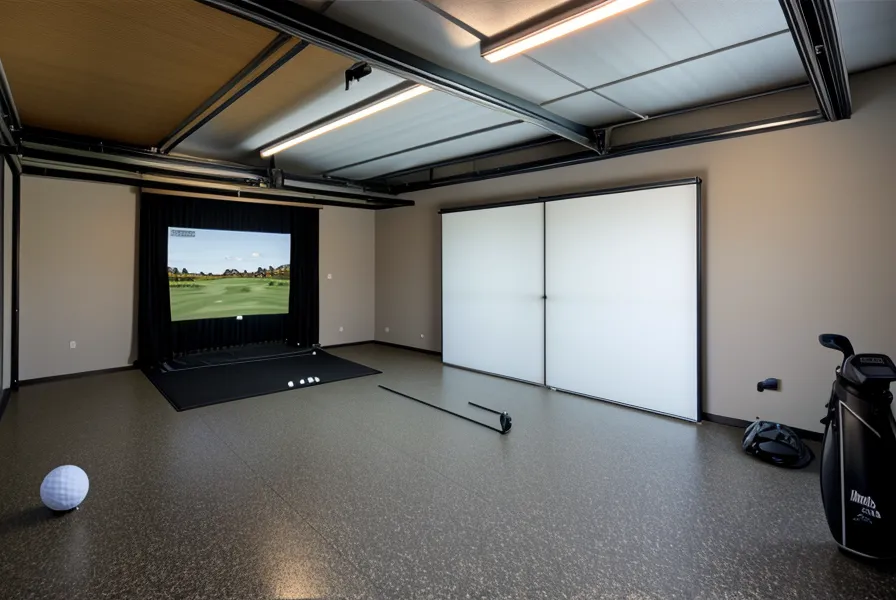
A mid-iron off a full swing travels north of ninety miles an hour, and a flat sheet of fabric has no business trying to stop that quietly. That's the gap most people miss when they put together a garage simulator: real money goes toward the launch monitor and the mat, then whatever screen happens to be cheapest gets hung up to catch the ball. Two years into running mine, questions about impact screens outnumber every other part of the build combined, probably because it's the one piece that's equal parts physics problem and not-waking-the-cul-de-sac problem. Consider this the collection of sim build tips I wish someone had handed me before I stood in an indoor golf shop guessing at size charts instead of measuring my own garage first.
My wife's only real condition for the whole project was that it couldn't sound like construction noise (a fair ask), and my first screen turned every mis-hit into a crack loud enough to carry down the block. Getting the screen right turned out to be less about picture quality and more about a handful of practical questions, so that's how I've laid this out — as answers, not a shopping list.
The difference between real impact screens and bedsheets with delusions
The honest answer is that a screen and a hitting net solve two different problems, and just how tough the fabric needs to be is really its own question — one I've gone deep on separately, so I won't repeat all of it here. What a screen buys you that a net can't is a flat, closed surface a projector can throw an image onto, which matters if you'd rather see a fairway in front of you than a chain-link view of your garage door. Picture the difference between a proper home-theater screen and a heavy canvas tarp: one is built to be looked at, the other to take a beating, and a real impact screen is trying, somewhat awkwardly, to be both at once.
Screen size is a garage math problem before it's a golfing one.
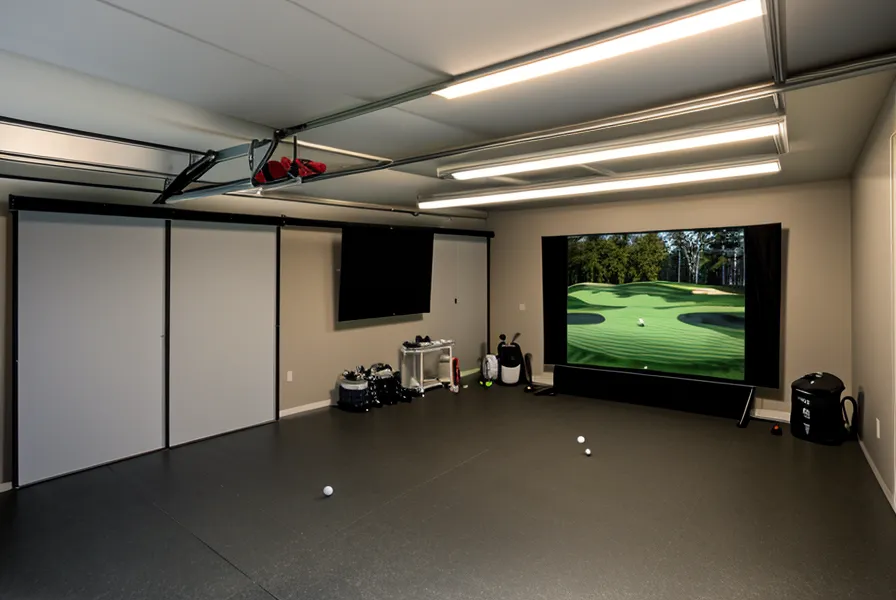
Getting the aspect ratio right is the first real decision, and it's less about image quality than about how much wall space you're willing to give up. A widescreen 16:9 screen looks like a proper theater, but it eats vertical space fast in a bay built for a car instead of a cinema. Going with a squarer 4:3 ratio filled more of the height without needing a room twenty feet wide, which matters in a hitting bay that only runs a shade under twenty feet from where I set up to the back wall. Nate Grullón, a builder I know from that same Discord, is running his whole setup in a single-car bay rather than a double, and every inch he gains on screen width has to come out of somewhere else — usually his swing path room on the backswing side.
Twelve inches of clearance behind the screen is non-negotiable.
Every manufacturer prints that number in the manual, and I ignored it for the first month because eight inches looked close enough by eye. One full driver swing at close to a hundred miles an hour later, I had a circular dent in the drywall about the size of a softball. A matching dent in my confidence. That foot of space lets the screen deflect and bleed off energy before the wall has to do the stopping, and drywall doesn't have any give to spare. If your garage forces you tighter than that, the fix isn't a stiffer screen — it's moving the hitting position forward, even if that costs a few feet of backswing room near the garage door.
Keeping the ball from bouncing back at your shins
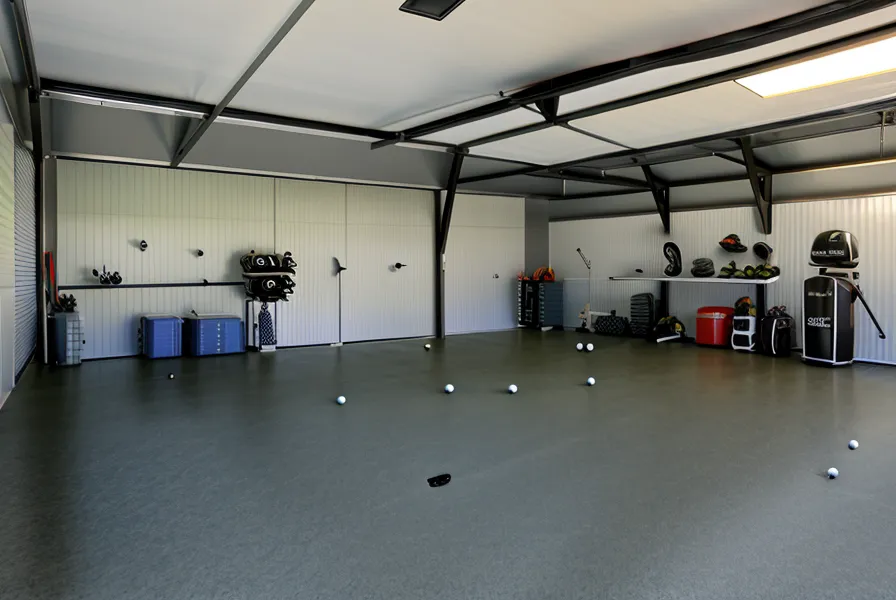
Pull a screen drum-tight and the image looks great and the bounce-back gets worse. The ball comes off the fabric with nearly as much energy as it arrived with, which is the wrong trade when you're standing eight or ten feet away. I've watched a smaller version of that same energy return on my hitting mat: catch a shot fat near the leading edge and the rubber tee snaps back to center almost too fast to see, and that's the identical physics problem playing out at screen scale with a lot more force behind it. Letting the screen carry a slight belly of slack in the middle kills that return speed and drops the ball dead at the base instead of sending it back toward your knees. It ruins the flat, showroom look people chase in build videos, but with a family SUV parked six feet away, that trade isn't close.
The projector fight, and the ceiling height nobody budgets for
Projector brightness and screen material interact more than most builders expect, especially if afternoon sun finds its way into a garage through a side window, but that's a deeper rabbit hole than a screen guide needs to cover. Ceiling height causes the other recurring headache, and I've written a full breakdown in Ceiling Height Reality Check: Why Your Driver Needs More Room Than You Think — the short version for screens specifically is that your frame's top crossbar has to clear a full wedge swing, not just a driver at address, or you'll eventually clip a light fixture.
The purchase that flat-out failed
Grommet spacing deserves its own mention, since a ball catching a metal grommet at speed can zip back at an angle nobody wants near their shins. That's more of a stray-shot problem than a screen problem, and I covered that ground in Best Golf Simulator Side Nets to Protect My Garage Walls for anyone whose mishits wander wide of the screen entirely. Not everything in this build earned its spot, either. Long before the screen went up, I grabbed a putting mat off someone's driveway at a garage sale, and within two weeks the concrete had it curling up at both edges like a stale slice of bread. That's a clear sign that flooring and mats need their own budget line instead of an afterthought. Conrad, a guy from my IT team a few builds ahead of me, usually has a spec comparison pulled up before I've finished typing the question in our group chat, and that habit alone has kept me from at least one more bad order.
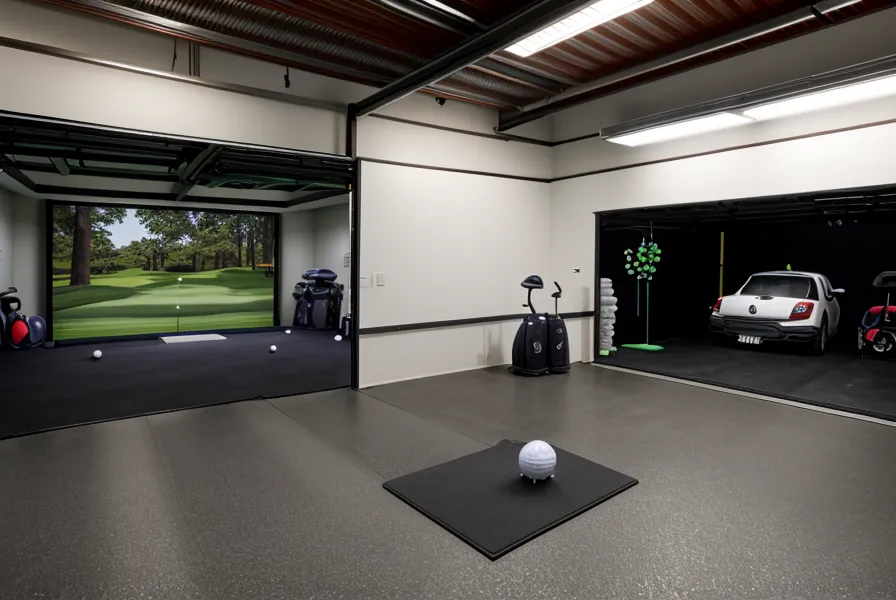
None of this matters much if the garage is too cold to stand in for long once the sun goes down, which is its own problem covered in Best Garage Heaters for Year Round Golf Simulator Practice. These days the screen holds a clean 4:3 picture, stays quiet on contact, and doesn't send anything back toward the SUV parked a few feet away. Twelve inches of clearance, the right denier, grommets kept out of the strike zone. None of it is complicated once you know which question to ask first.