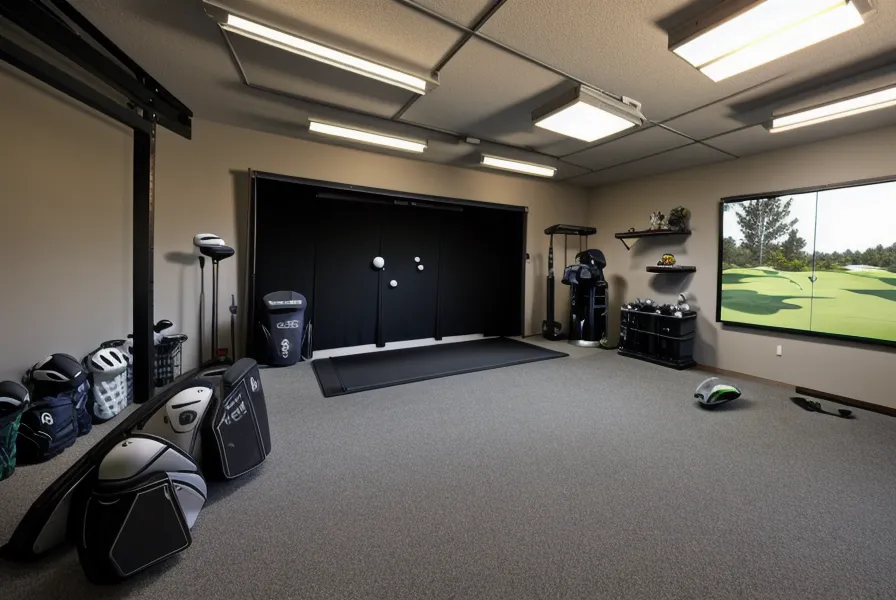
A forty-pound golf bag balanced on its own kickstand falls over eventually, and in a garage simulator it never tips toward the empty half of the floor. It goes for whatever cost the most to build -- the launch monitor, the impact screen, the projector lens. Golf bag storage isn't a garage organization nicety in a setup like this. It's one of the cheaper simulator essentials standing between your gear and a very bad Tuesday night.
None of what follows is theoretical. I only write about the racks and organizers I've actually wedged into my own garage, including a couple my wife made me box back up because they ate space that was never supposed to belong to golf.
The Storage Rack Myth Nobody Bothers to Correct
Ask around any golf forum about bag racks and the answer is always the same: buy one once the garage looks embarrassing enough. That's the myth, and it has the priority backwards. A rack in a simulator garage isn't a tidiness purchase -- it's the cheapest insurance policy on the room. A hundred dollars of welded steel standing between a leaning bag and gear that costs several times more isn't optional once you've actually priced out what's sitting on that concrete floor.
My own SkyTrak Golf setup reads ball flight off a photometric camera and dual radar, and that reading gets noisier the moment clutter sits between the sensor and the ball -- a stray headcover in the wrong spot is enough to throw off a number. The number that actually sold me on trusting the setup was a plain one: my 7-iron carried out to 156 yards on the monitor, the same figure printed on the scorecard at Lunken Golf Course over in Cincinnati's East End -- no rounding, no fudge factor, just the same number showing up twice. That kind of agreement only means something if nothing near the hitting area is quietly messing with the read.
What Is a Golf Bag Rack Actually Protecting?
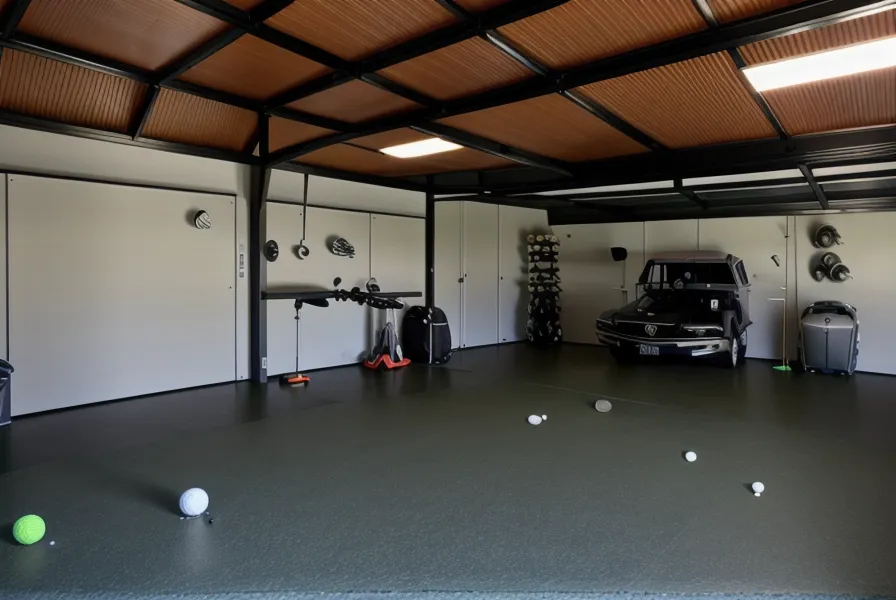
Start with what's genuinely sharing the floor. The primary bag is the obvious one, but the real space hog is usually a folded cart parked in the corner for the days you're actually walking nine somewhere real. I went hunting for a rack over at Golf Direct Now because I needed something that could also handle the folded footprint of my Alphard Golf Cybercart -- a cart good enough to have picked up a MyGolfSpy Best Overall nod, but a folding puzzle the second it's off the grass. Shelving matters as much as hooks: a launch monitor case, loose sleeves of balls, and a SWAG Golf putter all need somewhere that isn't the floor. Putters milled from 303 stainless steel don't belong leaning against a lawnmower, and a specialist source like the Indoor Golf Shop will tell you the same about anything with a milled face.
Floor-Standing or Wall-Mounted: Which Wins in a Sim Garage
Floor racks and wall racks solve different problems, and the tradeoff is real. A floor rack costs you depth between the ball and the screen. A wall rack costs you the wall space you were probably saving for something else. A full driver swing eats up real ceiling clearance, and once that's accounted for there's rarely a spare inch left over -- which almost pushed me toward a wall-mounted rack, until I remembered garage floors typically slope somewhere around an eighth of an inch per foot for drainage, and two full bags bolted into drywall anchors are asking a lot of studs that may not line up where you need them. A full staff bag runs 30 to 40 pounds. Hang two of those wrong and gravity settles the argument.
I also learned the hard way that not every floor fix helps. I tried a hardware-store rubber anti-fatigue mat under my front foot to ease the stance, and it compressed unevenly under weight and threw my balance off worse than bare concrete ever did. Mid-backswing, that matters. That's a mat problem, not a rack problem, but the lesson carries over: anything touching the floor near your stance has to sit dead level, mat or rack, or it works against you instead of for you. People spend so much time on the golf hitting net vs impact screen decision when they plan a build that they forget an unlevel rack tipping into that screen is a far more likely way to actually put a hole in it.
Guarding the Big-Ticket Gear in a Home Golf Studio
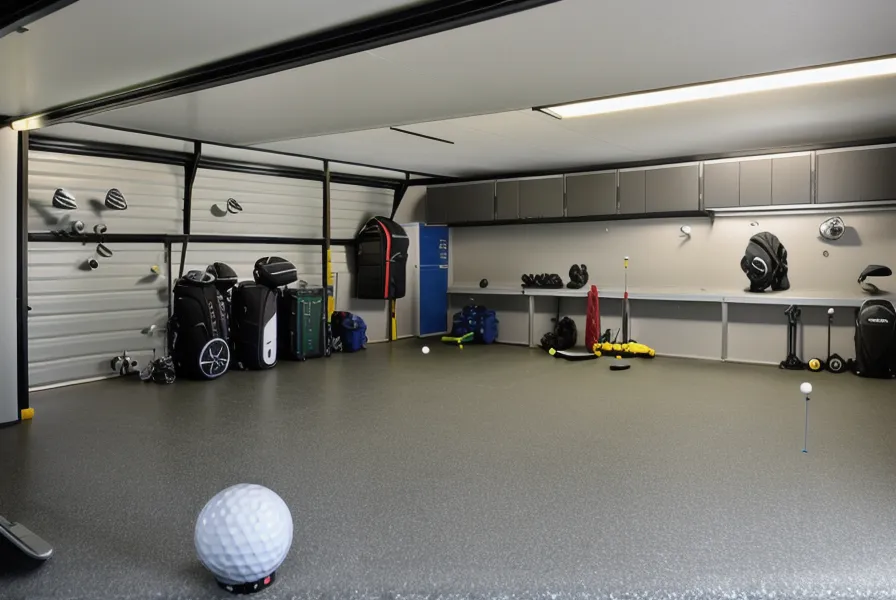
Do the math on what's actually at risk. A hundred-dollar rack is cheap insurance next to a build that ran close to five grand once every piece was in, and I already paid the three-hundred-dollar version of this lesson once, when a tipped bag drove a club through the high-tension fabric of my impact screen. You find out fast what a driver sounds like against that screen after that -- a flat, sharp pop, then a beat of echo off the wall behind it -- and a toppled bag is one more way to hear it on a shot you never swung. Keeping the floor clear also protects the numbers a launch monitor reports: ball speed, launch angle, spin rate, and carry distance all depend on a clean read, and a bag rack is one less obstruction near the hitting zone that a mis-hit could bounce off. Once the bags were off the floor, my top golf simulator shank nets could finally hang the way they were designed to instead of snagging on a bag handle every time a shot went sideways. It doesn't matter whether you're hitting into a full enclosure or an open bay -- the floor around the hitting zone is the one patch of ground that has to stay clear either way -- and a rack tucked flat against the wall won't throw a shadow across a projector image the way a leaning bag can.
Pick the Rack, Skip the Regret
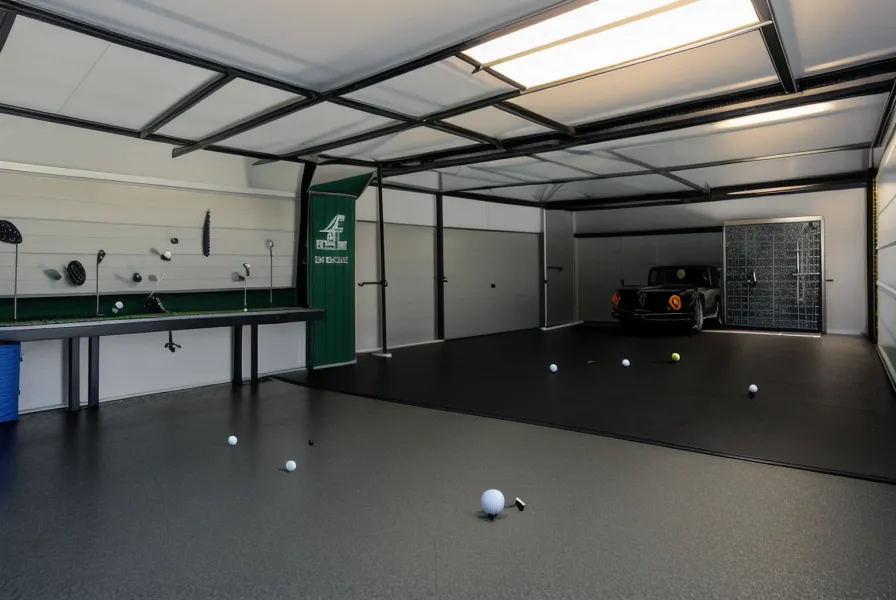
A neighbor down the street spends his Saturday mornings out at Winton Woods throwing discs instead of hitting balls, and even he took one look at my garage and asked where the rack came from -- which says the clutter problem reads as a problem even to people who've never swung a club. Here's the actual rule, if you want one: measure your floor depth and find your stud lines before you shop, not after. If you don't know exactly where the studs are, don't hang two 30-to-40-pound bags on drywall anchors and hope for the best -- get a floor-standing rack you can shim level and slide over if the setup ever shifts. If floor space is the tighter constraint and the studs line up clean, a wall-mounted rack buys back square footage you'll actually use.
Whichever way you land, source it from somewhere that stocks the category properly. A generalist like Golf Direct Now will put a backup driver and a push cart in the same order as a rack, while a build-specific outfit like the Indoor Golf Shop can lay a rack out against your actual garage dimensions before you commit to a single bolt hole. Get it measured and mounted before the next bag goes back on the floor. The hundred bucks is the cheap part of this whole build, and it's the part most people buy last instead of first.