The Garmin Went Back in Two Weeks. The SkyTrak Never Left.
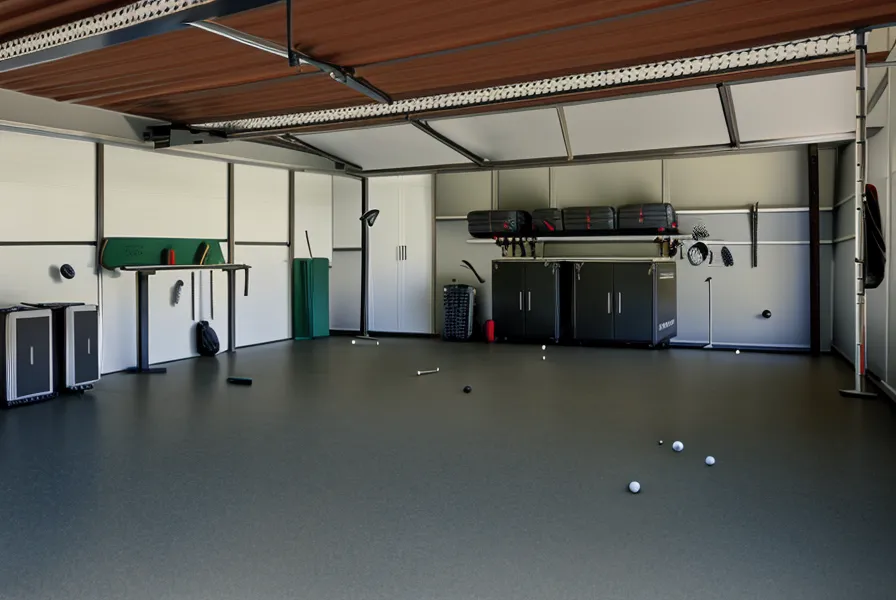
A Garmin Approach R10 gave me a ball speed number in under a minute. It took two weeks of low-light sessions in my garage to figure out that number couldn't be trusted, and the R10 went back in its box before the return window closed. That's the short version of how this garage golf simulator ended up built around a SkyTrak Golf setup instead -- the launch monitor almost everything else in this indoor golf simulator build gets organized around. Knee surgery is the reason there's a launch monitor in my garage at all; a couple years of reduced course time turned into a full two-car-bay experiment, and weighing gear side by side against what actually worked became half the hobby.
Ceiling clearance came before either monitor mattered. A nine-foot garage ceiling is about the minimum for a full driver swing, and even at nine feet you catch yourself eyeing the joists the same way you'd eye a garage door opener before backing a loaded truck in too fast. The full clearance math -- stance width, backswing arc, where the joists actually sit -- lives in my reality check on simulator builds, worth reading before you buy a projector you can't mount. Watching the tape measure come out for the third time that week got me a raised eyebrow and no comment from my wife (she'd seen this movie before).
The Launch Monitor Math: Photometric Camera vs. Radar in a Dark Garage
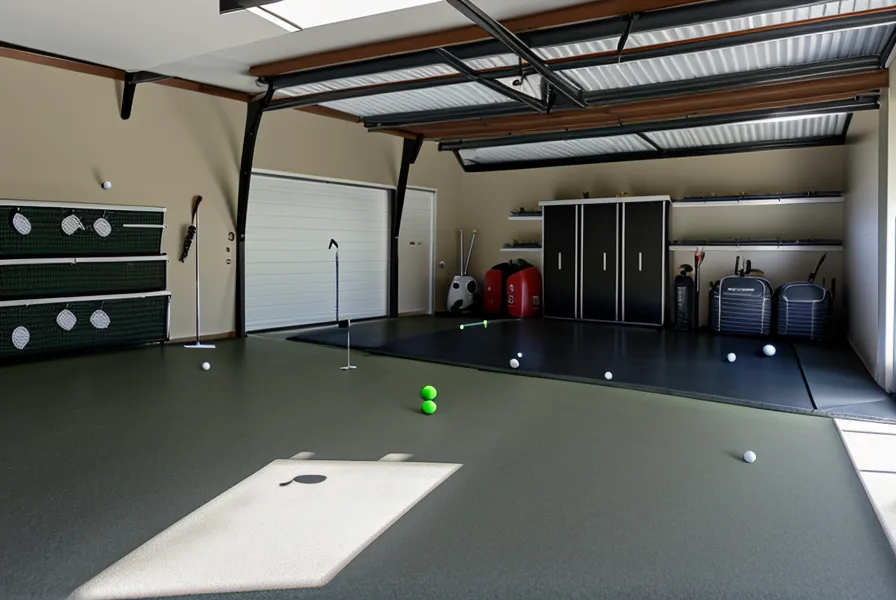
The core difference is simple. The R10 leans on Doppler radar to track the ball after it leaves the face, while the ST MAX pairs a photometric camera with radar to read the ball in its first few inches of flight. Outdoors, with real sunlight and forty yards of open grass, that distinction barely shows up. Indoors, with four walls close in and a garage light that's dim by six in the evening come December, it's the difference between a number worth building a swing change around and one you have to guess at -- my R10 kept serving up a phantom draw on 7-iron shots that never happened on video, and after the second week of chasing a swing flaw that wasn't real, it went back in the box.
Ball speed, launch angle, and spin rate are the three numbers I actually watch mid-session, and the ST MAX holds those steady swing after swing in a way the R10 never quite managed in my bay. Seven-iron carry sits around 155 yards with a swing speed in the mid-80s on a clean strike -- numbers steady enough that I trust them for a lesson plan instead of a guess.
Bundled Enclosure or Piecemeal Parts?
Mats turned into the more expensive lesson. The first one I bought felt like hitting concrete with a yoga mat laid over it, a bad plan a few months removed from knee surgery when every joint from ankle to elbow is still touchy about impact. There's a January session I still remember at nine at night, the slab never having warmed up all day, cold enough that I could feel it climbing through a thin-soled pair of trainers by the third or fourth swing regardless of what mat was underneath. That's when I stopped shopping mats one at a time and went through Indoor Golf Shop for a bundle pairing the mat with the enclosure and the impact screen instead, which cuts out the guesswork of matching three separate specs from three separate vendors.
That bundle also solved the screen - the fabric has to survive a ball coming off a driver face at well over a hundred miles an hour without a hole spreading through it after a few months, a different durability question than any mat has to answer, and a side net along the bay catches anything that comes off the heel or toe before it finds the drywall. Indoor Golf Shop's photometry-based launch monitor option reads the ball the same basic way the ST MAX does, camera first, which made comparing the two systems less confusing than expected. It's closer to buying a pre-built PC than sourcing a motherboard, memory, and a case separately and hoping everything's compatible -- though the actual laptop running the course software still chugs a little on the higher-resolution courses when three of us stack up for a Tuesday scramble, which is its own rabbit hole. My bay runs about nineteen feet from ball position to the back wall, enough room for a full driver follow-through without clipping the net, and the slab still carries a faint oil stain in the corner from whatever the previous owner parked there -- the ball finds that stain more often than seems statistically fair.
Lining up the hitting position, screen, and camera on one consistent axis took more fiddling than expected, since the alignment only holds if nothing's crowding the mat -- which is why the golf bags live on a wall rack now instead of stacked against the back wall. Anyone deciding whether the newer sensors in the step-up model are worth the difference over what I'm running should read the full comparison in SkyTrak vs SkyTrak Plus before spending more.
Does Garage Data Even Transfer to an Actual Scorecard?
Chadwick Obiero, a reader who emailed after my original SkyTrak-versus-Garmin comparison ran, is a good test case for how this plays out beyond my own garage. He sent over his exact ceiling measurement and three paragraphs of sharp questions about the ST MAX's course library, then bought a completely different monitor a week later because of a comment thread on a YouTube video. I don't fault him for it -- there's a lot of noise out there, and the honest answer is that either monitor can work depending on what you're chasing.
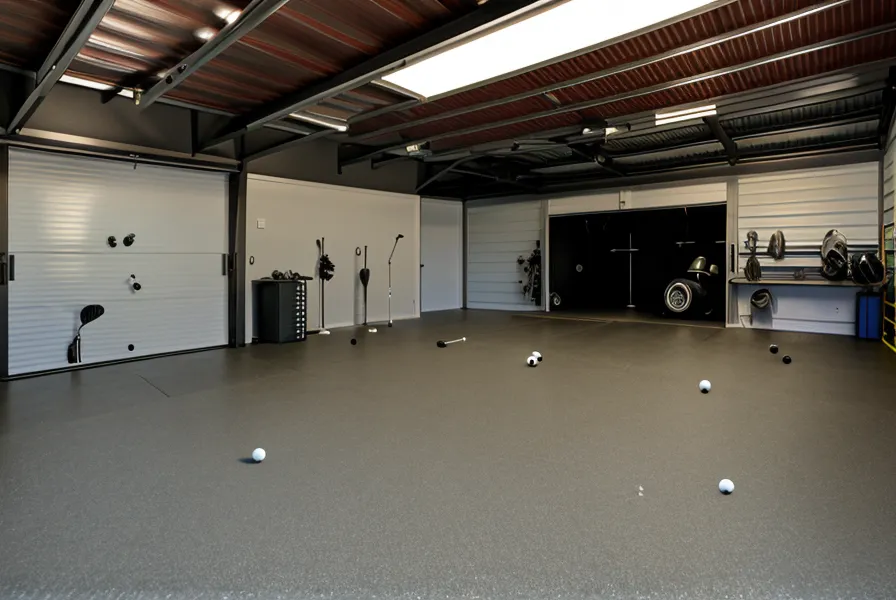
The real test came on an actual course, the first full round back after the garage sessions had piled up. Ball striking felt sharper than it had in years despite a knee still stiff on the back nine, mostly because I'd already seen my typical miss on a screen a hundred times over on Tuesday and Thursday nights and stopped being surprised by it. My recovery with SkyTrak post covers that transfer in more detail. Wes Quaranto, my neighbor across the street, still isn't buying it -- he plays in the same Wednesday scramble league I used to make every week before the surgery, and he'll argue over a beer that the course just feels different than a screen no matter how good the sensor gets.
My wife caught me at the laptop on a Sunday afternoon, back from an afternoon at Kenwood Towne Centre, scrolling through a spreadsheet of ball-speed numbers from the week's sessions like it was a hobby of its own -- which, at this point, it basically is. She didn't say much, just gave me the look that means she's stopped being surprised by any of this. Somewhere in that spreadsheet was proof the garage time works even on weeks the course doesn't cooperate.
Getting to that course also meant solving the walk, since a stiff knee and eighteen holes of carrying clubs don't mix anymore. An electric push cart from Alphard Golf handles that now, with a follow mode that trails a few steps behind so I'm not steering it one-handed mid-swing. Putting is still old-fashioned -- a milled SWAG Golf putter in stainless steel, the same material Anna Nordqvist used to win the 2021 AIG Women's Open, rolls the ball just as true on the practice green in the garage corner as it does on real grass.
Choosing Between the Garage Pick and the Generalist
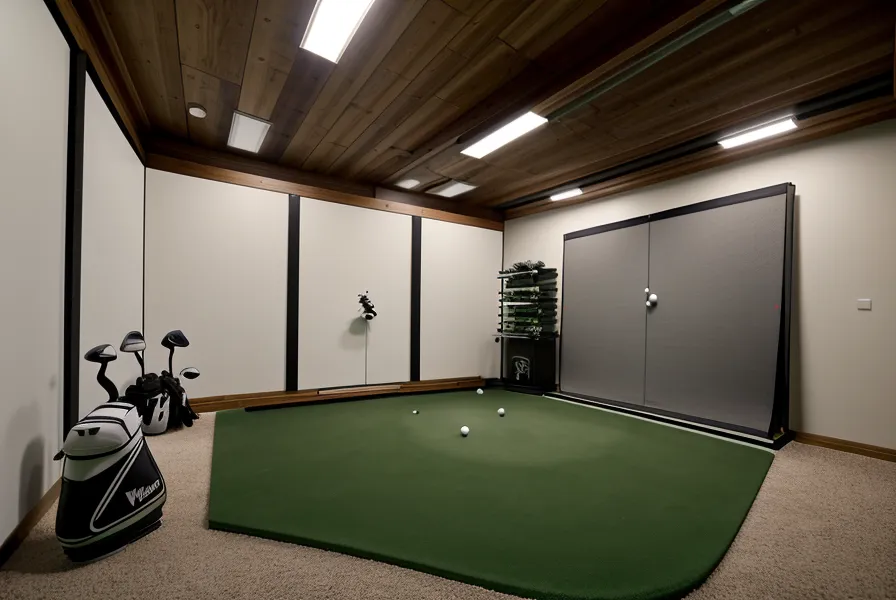
For backup wedges, a rangefinder, or anything generic, Golf Direct Now's price matching handles it without much thought, since the return policy risk on generalist gear is lower than an oddball retailer picked off a search result. The launch monitor and the enclosure are a different category entirely -- that's specialist territory, and going generalist there is how people end up doing exactly what I did with the R10: buying something that wasn't built for the room it landed in.
Most of what I've spent on this build went to the launch monitor and the enclosure, in that order, with mats and screens as the recurring smaller expense every time one wore out or got returned. A garage that runs cold or gets no heat in winter adds its own tax on top of that, since a photometric camera wants consistent light and a cold bay in February turns calibration into its own chore. If you're choosing between a portable radar unit and a camera-based system, the decision really comes down to where the box lives: a radar unit like the R10 earns its keep if it's also riding in your bag to the actual course, and a photometric setup like the ST MAX earns its keep if the garage is where most of your golf happens now. I'm under a wife-imposed ban on new SIM purchases until December 2026, so this is the setup staying put -- and for a two-car garage doing double duty as a golf bay, it's the one I'd buy again.
| Product | Rating | |
|---|---|---|
| SkyTrak Golf Garage Pick | 9.1 | Read More → |
| Indoor Golf Shop Best Bundles | 8.8 | Read More → |
| Golf Direct Now | 8.2 | Read More → |
| Alphard Golf | 8.5 | Read More → |
| SWAG Golf | 8.7 | Read More → |
SkyTrak Golf
Pros
- + Photometric and Doppler hybrid tech provides pro-level accuracy in tight garages
- + Reliable short-game spin data that radar-only units often miss indoors
- + Extensive software library including Pebble Beach and Pinehurst
- + Small footprint doesn't require 15 feet of ball flight
Cons
- ✗ Annual subscription required for the best course software
- ✗ Requires a sturdy level surface to avoid misreads