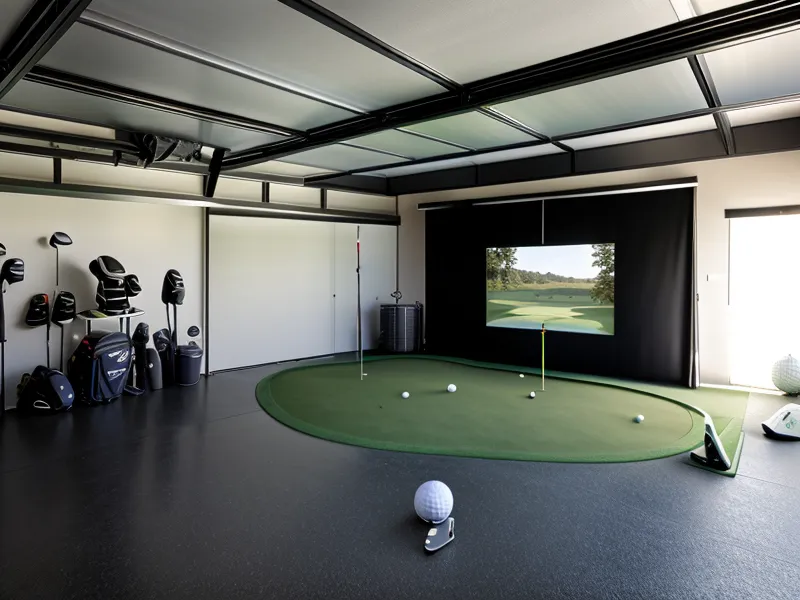
A ceiling-mounted camera system watches your whole swing from eight feet up, tracking club and ball together in one wide frame. A photometric unit like SkyTrak Golf never looks at your swing at all. It sits low, a few feet from the ball, takes a picture at contact, and calculates carry, spin, and speed from there. That single difference decided the launch monitor question for my garage golf simulator build before price ever entered the conversation, and it's why this particular indoor launch monitor ended up running my home golf setup instead of a ceiling rig.
Knee surgery a few years back trimmed my course rounds down to almost nothing, and a two-car garage build only made sense once I accepted I wasn't walking eighteen holes on a Saturday again anytime soon. The appeal now is playing Pebble Beach on a Tuesday night without leaving the driveway, and that only works if the data behind the software round is trustworthy.
Ceiling-Mounted Cameras Trade Convenience for Height
My garage tops out at nine feet, which is the one measurement nobody negotiates with a tape measure. Go lower and full-driver swings turn into partial wedges, permanently. It's a two-car garage on a cul-de-sac in suburban Cincinnati, half-cleared out for this project, and a ceiling-mounted camera rig needs real clearance above the swing plane to track the club through impact. The only one I've stood under in person was a demo bay at PGA Tour Superstore in Deerfield Township, mounted properly, with more ceiling than my garage will ever have. Ball-side photometric units skip that requirement entirely because the camera sits next to the ball instead of above the swing, which is the whole reason a nine-foot garage was ever workable. In the Cincinnati Golf Simulator Discord, a fellow garage builder named Nate Grullón asks about ceiling clearance in nearly every thread he starts, more than any other single topic, and it's usually the first wall a new build runs into.
Comparing Two Places to Buy Simulator Gear
Two retailers came up constantly while I researched this. Golf Direct Now carries a wide net of golf brands generally, useful if you also need a backup driver or a push cart in the same order, but its simulator-specific selection of mats, nets, and screens is thinner than a specialist's. Indoor Golf Shop is the opposite: narrower focus, deeper simulator catalog, and the source of the enclosure that now eats half my garage (my wife's reaction when the freight truck dropped off the SIG12 box was closer to a raised eyebrow than a sentence) — though a freight-shipped enclosure shows up as a delivery event, not a porch drop, so plan a helper and an afternoon for it. Price-wise, SkyTrak sat at $1,995 when I bought, while the newer ST MAX model retails north of $2,500; that $500 gap paid for my mat and most of the enclosure. A guy I work with in IT, Conrad Farawell, built his own simulator on a noticeably tighter budget than mine, and he'll tell you — unprompted — exactly how many dollars he saved doing it that way.
Why My First Putting Mat Failed on Concrete
The first mat I put down came from a garage sale a couple streets over, and it curled up at both ends within two weeks of sitting on poured concrete. Not confidence-inspiring for a knee that had already been through one surgery. Concrete doesn't forgive a bad mat the way turf does, and nineteen feet of slab between the ball and the back wall sounds like plenty of room until the enclosure and the screen distance eat most of it. Whether you enclose the whole bay or leave one side open is its own decision with its own trade-offs, and the SIG12 enclosure I mentioned earlier made that call for me by default. The garage door seals tight enough along the bottom edge that a shanked wedge shot doesn't find its way out to the driveway, which matters more than people expect until the day it actually happens. Impact screens fail slowly rather than dramatically, thread by thread, and mine still has plenty of life left in it. If you're earlier in a build than I was, The 2 AM Reality of a Garage Simulator: My First 30 Days with SkyTrak and the Best Golf Hitting Mats for Garage Simulators to Save Your Joints are both worth reading before you buy something off a folding table at a garage sale.
How Accurate Is the SkyTrak Data, Really?
A kitchen scale doesn't care what's happening on the rest of the counter — it only weighs what's on the plate. The SkyTrak works on the same principle: it only cares about the small window of air right above the ball, not what's going on ten feet up near the joists, which is why my workbench and lawnmower three feet behind me have never once thrown off a reading. Under the hood it's a high-speed photometric camera paired with dual Doppler radar, reading ball and club data without needing marked balls or sticker tags on the clubface, and it processes each swing in roughly one second — carry, ball speed, and spin all show up before I've finished my follow-through, and I've never noticed lag build up over a full eighteen-hole software round.
Between ball speed, carry distance, spin rate, and launch angle, there's more raw data on the screen than a 14-handicap strictly needs, but I'd rather have the full set and ignore half of it than wish I had it mid-round. Across a dozen sessions this spring, my driver has held in the 96-to-99 mph clubhead speed range session to session, tight enough that when a reading drops into the 80s, I know it's a mis-hit or a bad laser-dot alignment, not the sensor making things up.
The Putter, the Push Cart, and a Lighting Fix
None of this is strictly launch monitor territory, but it's part of the same budget conversation. I've thought about adding a SWAG Golf putter just to feel something premium on the foam mat, milled 303 stainless with the kind of face roll a foam mat can't fully show off, though the $399 price tag would likely start another budget conversation at home. On days I actually get out to a real course, the Alphard Golf Cybercart at $599 has been on my list to save the knee from pushing a bag around eighteen holes, though right now it's still a garage-only purchase idea.
Light matters more than people expect with a photometric camera, since it wants warm, consistent light rather than mixed daylight and shadow. My garage runs off a single eight-foot LED shop fixture mounted above the hitting bay, and getting the balance right meant moving the projector rather than the light itself — the projector mount writeup covers exactly what I changed and why.
Choosing Between Ball-Side and Ceiling-Mounted
The trade-off comes down to what your garage actually gives you. Choose a ceiling-mounted camera system if you've got real height to spare, want full swing-path video alongside ball data, and don't mind a more involved setup process. Choose a ball-side photometric unit if your ceiling is the limiting factor, your budget tops out well under five figures, and you'd rather place a ball on a laser dot than mount hardware near the joists. For a nine-foot garage on a suburban lot, that second column was never really a contest, and it's why SkyTrak Golf is still the unit running my Tuesday and Thursday nights, at a price that started at $1,995 and hasn't asked for anything since beyond the mat, the screen, and the enclosure I'd have needed no matter which launch monitor won.