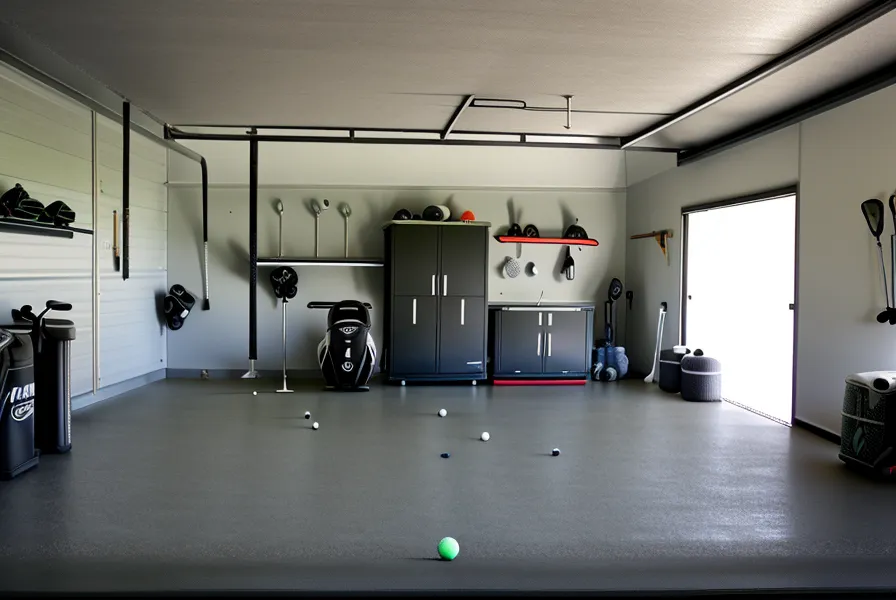
A Garmin R10 wants six to eight feet of open space behind the ball and another eight to ten feet of flight room in front of it before the spin numbers start telling the truth.
That single spec is most of the reason a SkyTrak vs Garmin R10 decision comes down to garage geometry more than brand loyalty. Eighteen feet of dead-straight floor is a big ask in a two-car bay that's still half full of a lawnmower and bins nobody's touched since the move, and it's the reason my own garage simulator build started with the R10 and ended up somewhere else. Every launch monitor comparison you'll read skips this part and jumps straight to spin-rate charts, which is backwards for anyone shopping indoor golf gear with a real ceiling and a real back wall to work around.
Quick disclosure before any of that: a few of the links below are affiliate links, and I earn a small commission if you buy through them at no extra cost to you. I've put close to $5,000 into this garage build over time, sending more than one piece of gear back when it didn't hold up, so none of this is a marketing brochure.
Six Feet of Runway the Garmin R10 Wants and My Garage Doesn't Have
The Doppler radar inside the R10 needs room behind the ball and room in front of it, the same way a camera operator backs up to fit a whole scene in frame instead of just an actor's shoulder. My ceiling sits at nine feet, tight enough that a full driver swing clips the theoretical top of the arc without ever touching the joists, and depth turned out to be the harder number to hit. Eighteen feet of clear, dead-straight space in a half-cleared two-car garage on a cul-de-sac in suburban Cincinnati is not a given once you've kept the workbench and a couple of bikes along the back wall.
When the radar loses that runway, spin math gets shaky, and a 7-iron you know carries around 155 yards on a good day will suddenly read closer to 190 on the screen, which tells you more about the empty space behind you than about your ballstriking.
How SkyTrak's Camera Setup Fits a Nine-Foot Ceiling
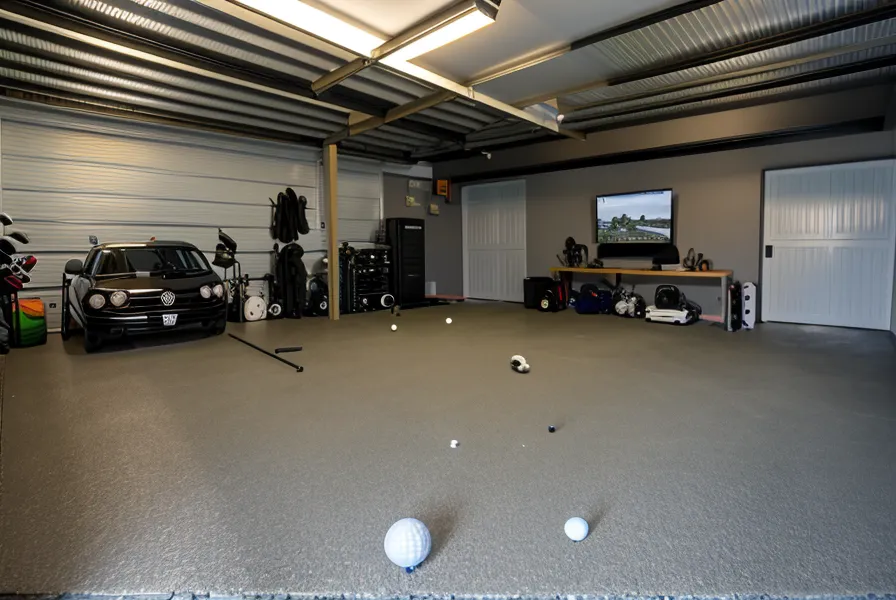
SkyTrak Golf solves the runway problem by using photogrammetry — a set of high-speed cameras — instead of radar, and it only has to see the first few inches of the ball leaving the clubface. It sits parallel to the ball, about a foot off to the side, closer to a security camera watching one doorway than a radar gun tracking a car down a highway. That difference in reach is what let me push my hitting mat within a few feet of the impact screen and still keep the back wall clear for the bikes.
Ball position to the back wall in my bay runs right around nineteen feet total, which sounds like plenty until you subtract mat depth, screen clearance, and the width of an open garage door sealed along the bottom to keep the draft out. Indoor golf gear eats space in ways a spec sheet never mentions.
For anyone who'd rather not source a mat, screen, and mount separately and hope they all fit together, Indoor Golf Shop will lay out a bundle around your actual garage dimensions instead of guessing — worth a look before you buy each piece on your own.
Nate, a guy I know from the Cincinnati golf sim Discord, asks about ceiling clearance in nearly every message he sends me, more than any other single topic. I've laid out the actual math on how much headroom a full driver swing eats in Real Garage Golf Simulator Space Requirements for a Full Swing, so I'll just say here that nine feet is tighter than the tape measure makes it look.
The 7-Iron and Driver Numbers That Actually Matched the Course
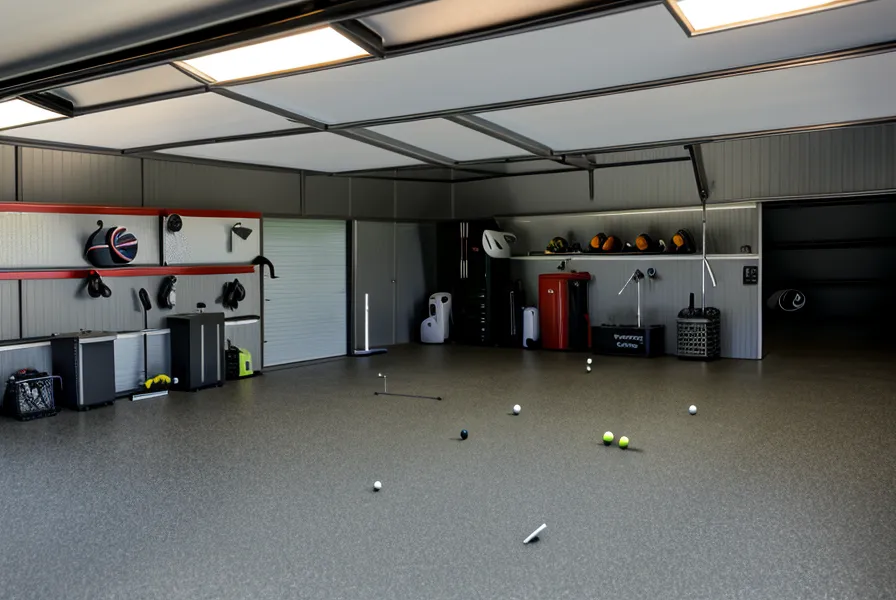
On the SkyTrak, my 7-iron carry sits consistently around 155 yards with a swing speed near 82 miles an hour, and the driver reads somewhere around 98. Those numbers track close enough to what I see on an actual round that I trust the practice sessions instead of second-guessing every reading.
The clearest proof came on the eighteenth at Pebble Beach inside the simulator, where four separate approach shots landed inside an eight-yard oval on the dispersion chart — tight enough grouping that it stopped looking like a guess and started looking like my actual swing.
I ran the driver and a wedge through both units back to back one session, and the full breakdown of exactly where ball speed and spin start to diverge between the two is its own writeup — this one's strictly about whether either box fits in your bay to begin with.
Both machines report the same basic menu — ball speed, launch angle, spin rate, club path — and which of those each one measures directly versus estimates is a longer conversation than fits here.
None of that data matters much if the mat under your front foot is fighting your knees on every strike. Mine behaves more like a yoga mat than the thin range mats I grew up hitting off, and how much give a mat should have under a punishing iron shot is a separate rabbit hole worth its own post.
My colleague Conrad, who built his own basement setup on a much tighter budget and still brings up how little he spent on it, would take the R10 in a heartbeat, and for anyone with the runway to spare, he's not wrong to.
Once the hardware's dialed in, the software layer is what keeps the sessions from getting stale. I've got a full rundown of Best Golf Simulator Software for SkyTrak Users This Year if you want the practice mode turned into something closer to a game than a chore.
Choosing Between Them for a Small Garage
Space isn't the only variable, though it's the one nobody mentions until it's too late. The first impact screen panel I hung was a foam-padded piece that split clean along the seam after the third bucket of balls — not the third month, the third bucket. That taught me screen material matters as much as launch monitor accuracy, and it's a durability question big enough for its own comparison rather than a footnote here.
Whether you build a full enclosure around the bay or leave the screen hanging against a bare wall changes the room math too, and it's a decision that comes after the launch monitor choice, not before it.
A camera-based unit also cares about how much daylight is bouncing off the garage door, which is a lighting problem worth its own writeup rather than a paragraph tacked onto a device comparison.
None of this accounts for what happens when a shot misses the screen outright, which is a netting question with its own answer elsewhere.
My slab has enough of a pitch toward the garage door that it was worth checking with a level before I bolted the mat frame down. Getting a concrete floor truly level is its own project, separate from picking a launch monitor.
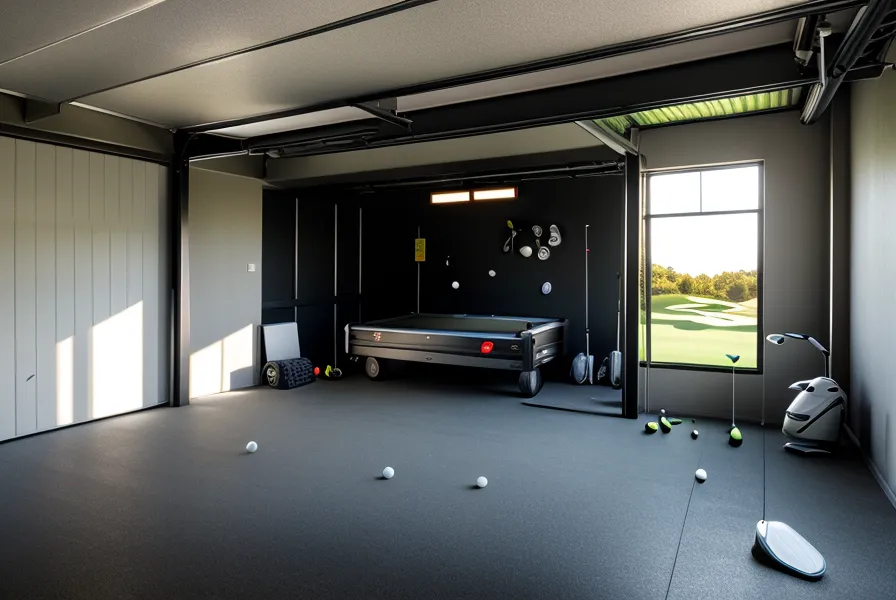
If you've got a pole barn, a twenty-five-foot basement, or any space where eighteen feet of dead-straight runway isn't a fight, the Garmin R10 is the better dollar-for-dollar buy and there's no reason to spend more solving a problem you don't have. If your bay looks more like mine, a half-cleared two-car garage with nine feet of ceiling and every foot of depth already spoken for, the camera-based SkyTrak earns its higher price by fitting the room instead of fighting it. I priced a couple of the components I eventually swapped out through Golf Direct Now before deciding the accuracy trade-off wasn't worth it in a space this tight.
Measure your own depth before you decide anything else — ceiling height gets all the attention, but it's the runway behind the ball that actually determines which of these two you should buy. For a garage shaped like mine, SkyTrak Golf is the one that stayed, and it's the one I'd point a fellow small-garage builder toward first.